
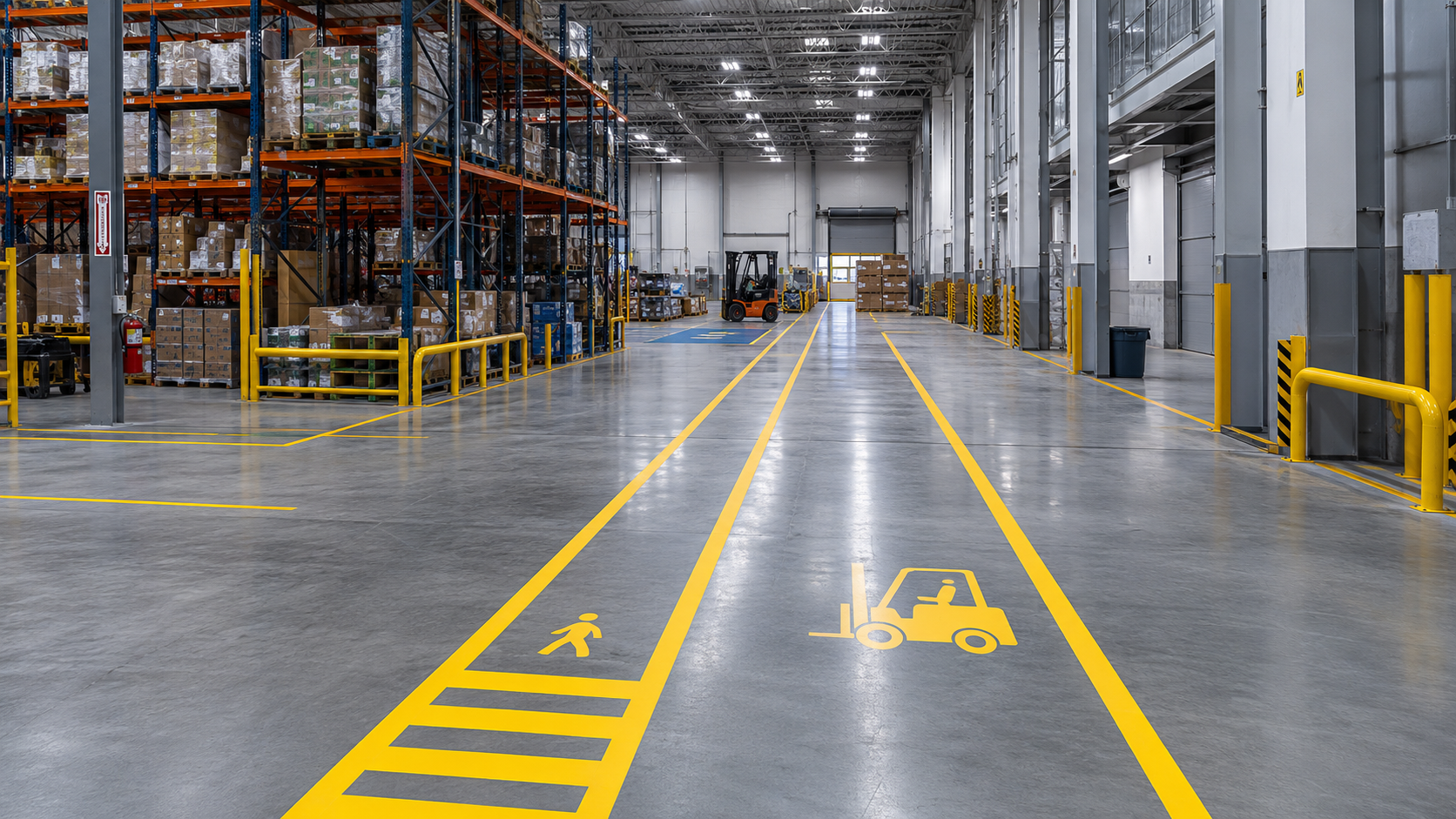
Why Floor Marking Color Standards Exist
Warehouse and industrial floor markings aren't just about keeping forklifts in lanes. They're a visual language — a system of color-coded signals that tells every worker in the facility what a zone is, what behavior is expected there, and what hazards or equipment are nearby. When that language is consistent, workers understand it intuitively. When it's inconsistent — when "yellow" means something different in Building A than it does in Building B, or when old markings from a previous tenant are still partially visible — the system breaks down and the safety benefit largely disappears.
This guide covers the standard color conventions used in warehouse floor marking, the OSHA regulations that underpin them, and how to think about specifying a floor marking project for your Huntsville, Madison, or Decatur warehouse or distribution facility.
OSHA 1910.22: The Baseline Standard
OSHA's walking-working surfaces standard — specifically 29 CFR 1910.22 — is the federal regulation most directly applicable to warehouse aisle marking. The relevant sections establish that:
- Permanent aisles and passageways must be "appropriately marked."
- The floor of every workroom must be maintained in a clean and dry condition as far as possible.
- Where wet processes are used, drainage must be maintained and dry standing places provided where practicable.
What OSHA 1910.22 does not do is specify exactly which colors to use for which purposes. OSHA sets the requirement that aisles be marked; industry practice and ANSI/ASSP Z535 standards fill in the color conventions. This is an important distinction — the color conventions you'll read about below are widely adopted industry standards, not OSHA mandates in the strict sense. But OSHA inspectors are familiar with these conventions and deviations from them can support broader citations for inadequate marking or unsafe conditions.
The practical implication: you won't find an OSHA citation that says "your blue lines should have been yellow." But you may find a citation for inadequately marked aisles or unmarked hazard zones, and the defense for "adequate marking" is typically adherence to recognized industry color conventions.
ANSI/ASSP Z535.2 (Environmental and Facility Safety Signs) and Z535.5 (Safety Tags and Barricade Tapes) also inform best practice for color use in industrial facilities and are worth consulting for facilities building or overhauling a safety marking system.
Standard Warehouse Floor Marking Colors and What They Mean
The following color conventions are the most widely adopted in U.S. warehouses and distribution centers, and are consistent with ANSI Z535 safety color standards.
Yellow: Traffic Lanes and Pedestrian Pathways
Yellow is the dominant color in most warehouses and the one that does the most work. It's used for:
- Forklift and powered industrial truck traffic lanes
- Pedestrian walkways and cross-aisles
- Aisle boundaries and edge markings
- Caution zones that aren't necessarily hazardous but require attention
Yellow has the highest visibility of the standard warehouse colors on most concrete floor surfaces and is the default for anything related to movement through the facility. When in doubt about what color to use for a traffic or pedestrian path, use yellow. The familiarity of yellow-as-caution is so universal that even brand-new workers understand it intuitively.
Yellow corner markers — typically L-shaped or chevron marks at the corners of columns, racks, and walls — are also standard practice in high-traffic forklift areas. These corner marks warn forklift operators of fixed obstacles in their turning radius and reduce rack damage significantly.
White: Work Areas and Equipment Locations
White is used to delineate work areas, workstations, and equipment positions. Typical uses include:
- Outlines of workstation cells or production areas
- Equipment positioning marks (where a specific machine should sit)
- Material staging zones (where incoming or outgoing inventory is positioned)
- Office areas within a warehouse floor
White is also used in 5S and lean manufacturing environments to mark the "home position" for tools and mobile equipment — the designated parking spot for a particular cart, pallet jack, or trash bin. When everything has a marked home, housekeeping audits are faster and deviations are immediately visible.
Red: Fire Safety Equipment and Hazards
Red is reserved for fire safety and the most serious hazards. Uses include:
- Fire extinguisher locations and access zones
- Sprinkler head clearance zones (typically a 36-inch circle or square around each head)
- Fire hose cabinet access areas
- Emergency stop buttons and safety switch locations
- Defective product quarantine areas
- Scrap and reject zones in manufacturing environments
The critical rule with red is to protect access. A red zone means "do not block this area." Fire extinguishers that are blocked by pallets, racking, or equipment are a code violation and a life-safety issue. Red floor marking around the base of extinguisher brackets and access panels communicates this requirement visually to anyone stacking material in the area — and creates a clear, documentable standard for housekeeping enforcement.
Orange: Caution and Inspection Zones
Orange is used to signal caution — not an immediate hazard, but an area that requires awareness. Common uses include:
- Material inspection or quality hold zones
- Equipment under maintenance or lockout/tagout
- Temporary hazard demarcation
- Pinch points or mechanical hazard areas
In practice, orange is less frequently used in floor marking than yellow, white, or red, and is more common in manufacturing environments with inspection stations than in pure warehousing operations. Some facilities skip orange entirely and use yellow tape or signage to handle caution applications. If your facility uses orange, be consistent and document what it means in your safety program so new employees learn the convention correctly.
Blue: Informational Markings and ADA
Blue is used for informational purposes and for ADA-related markings. Uses include:
- Informational zones (bulletin board areas, safety information stations)
- ADA accessible parking stalls on warehouse loading dock aprons
- Protective equipment stations (where PPE is required or available)
- Cold storage or temperature-controlled zone boundaries in some facilities
Blue is a non-hazard color — it communicates information rather than danger. In warehouses with loading dock parking, blue is used (consistent with outdoor commercial lot standards) for accessible parking designations, access aisles, and ISA symbol fields.
Green: Safety Equipment and First Aid
Green is associated with safety, emergency egress, and first aid. Uses include:
- First aid station locations and access zones
- Emergency eyewash and safety shower stations
- Emergency exit pathways
- Safety equipment storage (respirators, harnesses, hearing protection)
First aid station access is particularly important to keep clear and well-marked. OSHA requires first aid supplies to be "readily accessible" — a vague standard that is significantly harder to defend if the first aid station is blocked by a pallet or if the floor markings around it have faded to the point where the station isn't immediately identifiable. Green floor marking around eyewash stations and first aid cabinets, combined with overhead signage, constitutes a defensible standard of care.
Why Consistent Color Use Matters for New Employees
Worker onboarding in a warehouse or distribution facility is faster and more effective when floor markings are consistent and well-maintained. A new hire who learns the color system on Day 1 — yellow is traffic, red is fire safety, white is work areas, green is first aid — can navigate any part of the facility independently by the end of the first week. A facility with inconsistent or partially faded markings requires managers to verbally explain "what that color means here" for every zone, and workers who miss those explanations create safety risks.
The OSHA General Duty Clause (Section 5(a)(1)) requires employers to provide a workplace free from recognized hazards likely to cause death or serious physical harm. Inadequate marking that contributes to forklift-pedestrian incidents, blocked fire equipment, or obstructed emergency exits is a recognized hazard. Consistent floor marking is one of the most cost-effective investments a warehouse operator can make in OSHA compliance and incident prevention.
How Floor Marking Connects to a Broader Safety Program
Floor marking is most effective when it's part of a documented safety system rather than an isolated maintenance task. That means:
A written color standard. Document what each color means in your facility, include it in new hire orientation materials, and post a legend near the entrance or break room. This takes 30 minutes to create and pays dividends every time a new employee starts.
A maintenance schedule. Floor markings in high-traffic forklift aisles can wear significantly within 12–24 months. Epoxy-based markings in active forklift zones typically need inspection quarterly and reapplication every 1–3 years depending on traffic intensity. Including floor marking in your facility's annual maintenance budget — rather than waiting until markings are so faded they're unrecognizable — keeps the safety system functional.
Integration with lockout/tagout and emergency response plans. Your floor marking system should be referenced in your LOTO procedures (orange zones around equipment under maintenance) and your emergency response plan (green egress routes, red fire equipment zones). If these documents reference colors or zones by name, those names should match what's actually on the floor.
Coordination with racking and layout changes. Every time you change the facility layout — add a rack row, move a workstation, reconfigure a staging area — the floor markings need to be updated. Outdated markings that reference a previous layout create confusion and can actively mislead workers about traffic paths and hazard zones. Budget for a partial re-mark any time you make a significant layout change.
How to Spec a Floor Marking Project for Your Warehouse
When you're ready to plan a warehouse floor marking project, here's the information a professional striping contractor will need to give you an accurate quote:
- Facility square footage and aisle length. Total linear footage of aisle marking is the primary pricing driver. Know the total footprint of the area to be marked.
- Floor surface type. Sealed concrete, unsealed concrete, epoxy-coated floor, and painted concrete all accept marking products differently. The contractor needs to know the substrate to specify the right product.
- Traffic intensity. A cross-dock facility running forklifts 24 hours a day needs a more durable product than a light manufacturing shop with one forklift. Heavy traffic justifies epoxy or polyurethane-based floor paint over standard alkyd traffic paint.
- Color requirements. Provide your color standard or accept the contractor's recommendation. Be specific about which zones need which colors.
- Stencil and symbol requirements. ISA symbols for accessible areas, directional arrows, hazard text stencils, and zone designation lettering all add to the scope.
- Operational constraints. Can sections of the facility be shut down for marking? If forklifts run around the clock, the job may need to be done in phases over multiple nights or weekends.
For warehouse floor marking in the Huntsville, Madison, and Decatur areas, the same professional approach that produces consistent parking lot results applies indoors. For more on what's involved in a full line striping project, visit the Huntsville Stripe Pros main page or our overview of warehouse floor striping and safety lines. To request a quote for your facility, submit a request through the homepage.