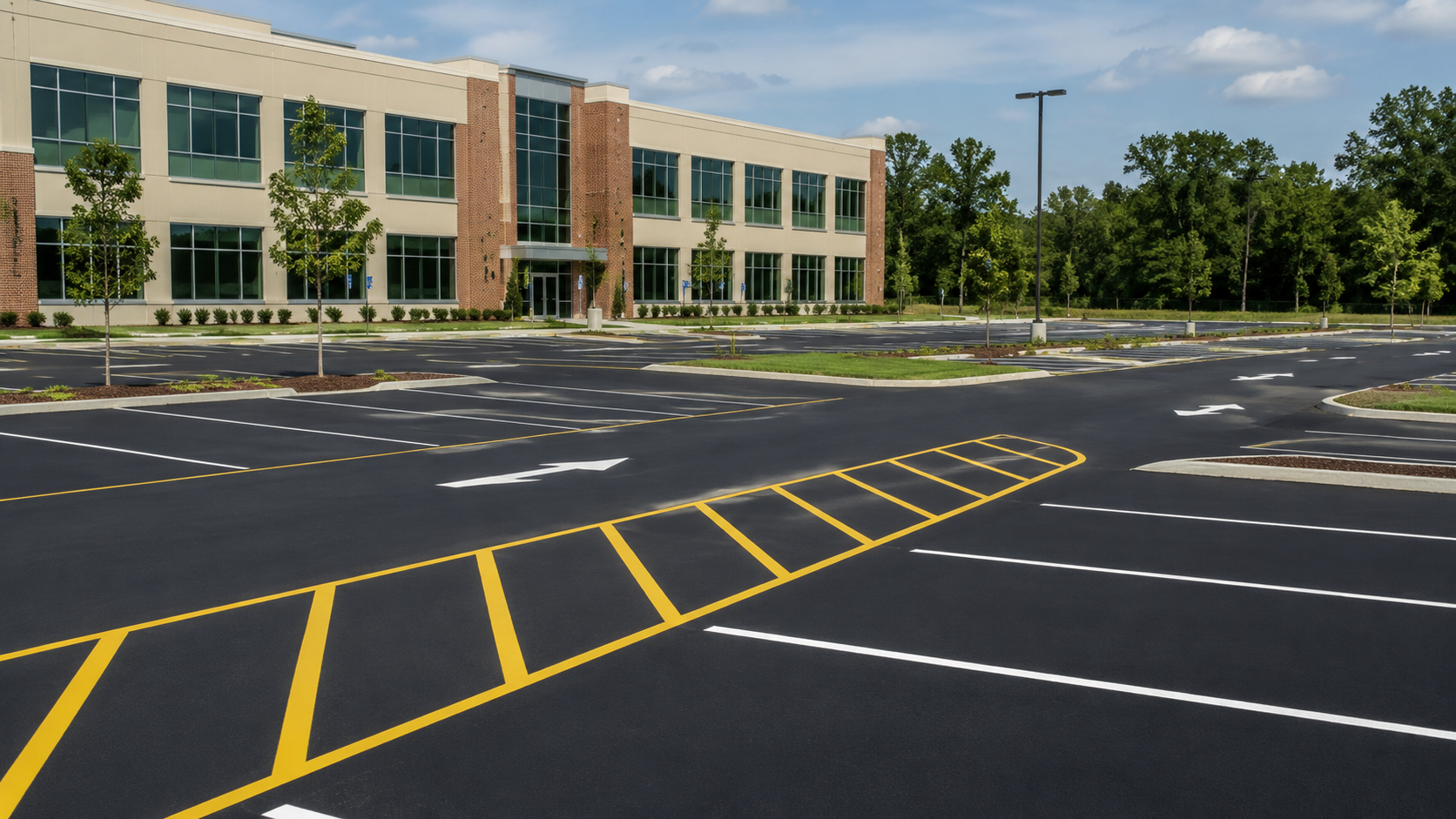
Why Clear Parking Lines Matter for Commercial Properties
Parking lot striping is one of the most visible indicators of how well a property is maintained. When stall lines are sharp, drivers can enter, park, and exit a lot confidently. When lines are faded or absent, confusion sets in: vehicles park at odd angles, fire lanes get blocked, pedestrians walk in unmarked paths, and property managers field complaints. For commercial properties along high-traffic corridors like University Drive, Memorial Parkway, and the Research Park area near I-565, a clean and readable lot is part of the property’s everyday presentation to thousands of passersby. Retail centers, medical offices, apartment complexes, churches, and distribution warehouses in the Huntsville area all share one thing in common: their parking lots are often the first thing customers, tenants, patients, and visitors interact with. A freshly striped lot signals that ownership pays attention to details. Beyond aesthetics, clearly marked lots reduce the likelihood of fender-benders in tight spaces, help emergency vehicles identify and access fire lanes quickly, and make accessible parking spaces easy to find and use. Property managers juggling multiple sites in Madison County understand that deferred striping eventually becomes a liability, not just an eyesore. Requesting striping before lines fully disappear is far more straightforward than starting from scratch on a lot where original layout marks have worn away completely.
Property Types We Help Across Huntsville
Commercial striping requests in Huntsville come from a wide range of property categories, and each has its own priorities. Retail shopping centers along University Drive and South Memorial Parkway deal with high daily turnover, meaning faded lines cause constant confusion during peak hours. Maximizing stall counts while keeping drive aisles clear and ADA spaces properly marked is essential for these properties. Medical office buildings and clinic campuses near Huntsville Hospital and the Research Park medical corridor face additional scrutiny on accessible parking because patients with mobility challenges depend on clear and functional accessible stalls and access aisles every single day. Churches and community facilities often have large surface lots that sit mostly empty six days a week but face intense use on weekends. Over time, sun and weather wear lines down, and a restripe before major events or seasonal programs makes a real difference. Apartment communities need stall assignments, visitor parking zones, reserved areas, and fire lane markings that stay visible year-round as residents and guests navigate the property daily. Industrial and warehouse properties along the I-565 corridor and near the Huntsville International Airport area have different concerns: dock boundaries, loading zones, directional arrows through drive lanes, and safety markings that keep pedestrian and vehicle paths clearly separated. Downtown Huntsville properties and mixed-use developments have unique layout constraints, often involving angled parking, tighter aisles, and visible pedestrian crossings. Each property type benefits from a striping plan tailored to its actual traffic patterns, tenant mix, and physical layout.
New Layout vs. Restripe: What’s the Difference?
Understanding whether your project is a new layout or a restripe helps set expectations for the estimate process. A new layout applies when asphalt has been freshly paved with no previous markings, when a lot is being reconfigured with a different stall count or drive aisle design, or when the original layout was so poorly designed that a fresh start makes more sense than painting over old lines. New layouts require measuring and staking the lot, determining stall widths and drive aisle dimensions, and confirming the location of ADA spaces, fire lanes, crosswalks, and any specialty markings before the first line is painted. A restripe, by contrast, follows the existing layout by painting over faded lines with fresh paint. This is faster and less expensive than a new layout but requires that the original line positions still be visible enough to follow, or that documentation of the original layout is available. Many lots fall somewhere in between: the basic stall grid can be restriped, but arrows have shifted, fire lanes need to be repositioned, or ADA spaces need to be refreshed with updated dimensions and symbols. Discussing the current lot condition and any desired layout changes at the time of your estimate request helps providers plan the project accurately and avoid unexpected scope changes mid-job.
What Gets Striped: Markings Overview
A full commercial parking lot striping project typically involves more than just stall lines. Standard stalls are painted in white or yellow at widths that accommodate current vehicle sizes while balancing stall count. Directional arrows and one-way markings guide drivers through drive aisles, reducing the congestion and near-misses that happen when traffic flow is unclear. Stop bars at lot exits and pedestrian crossing points tell drivers exactly where to stop before proceeding. ADA accessible stalls require specific dimensions, proper access aisle widths beside them, blue surface paint or markings, and ISA (International Symbol of Accessibility) pavement symbols. Van-accessible stalls have wider access aisles and need to be identified separately from standard accessible spaces. Fire lanes along building faces and drive aisles need to be clearly marked with FIRE LANE stenciling and often red or yellow curb paint so that the path to the building is never obstructed by parked vehicles. Pedestrian crosswalks at building entrances and between parking areas and storefronts improve pedestrian safety and give drivers clear visual cues to yield. Loading zones, reserved spaces, visitor parking, and no-parking areas can all be designated with custom stencils. On larger lots, all of these elements work together as a system, and a well-planned striping project accounts for how each marking type interacts with the others.
Scheduling Around Active Business Hours
One of the most practical concerns for property managers requesting striping on an active lot is timing. Paint needs a period of unobstructed cure time before vehicles can use the freshly marked stalls, and water-based traffic paints typically need at least 30 to 60 minutes before foot traffic and a couple of hours before vehicle traffic, depending on temperature, humidity, and the specific product used. For high-traffic retail and medical properties that cannot close their lots during business hours, after-hours and overnight striping is a common solution. Properties along busy corridors like University Drive or near the Parkway Place area can often be striped during overnight windows when vehicle counts drop significantly. Churches, schools, and event venues that have predictable low-use periods during the week are often easier to schedule during daytime hours. For large lots that cannot be completed in a single session, phased striping — blocking off sections in sequence — can keep the majority of the lot operational while work progresses. When requesting an estimate, sharing your operating hours, any blackout periods, and preferred scheduling windows helps providers plan a realistic production schedule.
What to Prepare When Requesting a Quote
Getting an accurate estimate for parking lot striping is much easier when you come prepared with some basic information about your property. Start with the approximate lot size in square feet or the number of parking stalls if known. If you have a site plan or aerial image from Google Maps, that gives a provider a good starting point for understanding the layout. Note the current surface condition: is the lot fresh asphalt awaiting first-time striping, an older lot being restriped, or a recently sealcoated surface? Each surface condition affects how paint adheres and how much preparation is needed. Describe the scope of markings you need: standard stalls only, or a full package including arrows, stop bars, ADA spaces, fire lane markings, crosswalks, and curb painting. If the project is a restripe, mention whether the original layout is staying the same or if changes are planned. Share the property address so providers familiar with Huntsville’s neighborhoods and commercial corridors can factor in access, parking, and any local characteristics. Finally, if you have a target completion date or scheduling constraints, communicate those upfront so the estimate can account for production scheduling. The more detail you provide, the more useful and accurate the estimate you receive will be.