How Toyota and Limestone County growth are driving new striping demand in Athens
Athens has been one of the more quietly dramatic growth stories in North Alabama. The Toyota Motor Manufacturing Alabama plant, located in the northern Athens area and producing the Toyota Corolla, brought with it not just direct employment but a tier-one and tier-two supplier network, logistics and distribution operations, and a wave of population growth that has compounded through the county's residential and commercial base for two decades. Limestone County is now regularly cited as the fastest-growing county in Alabama, and that growth is converting what was once rural land along the I-65 and US 72 corridors into commercial development at a consistent pace.
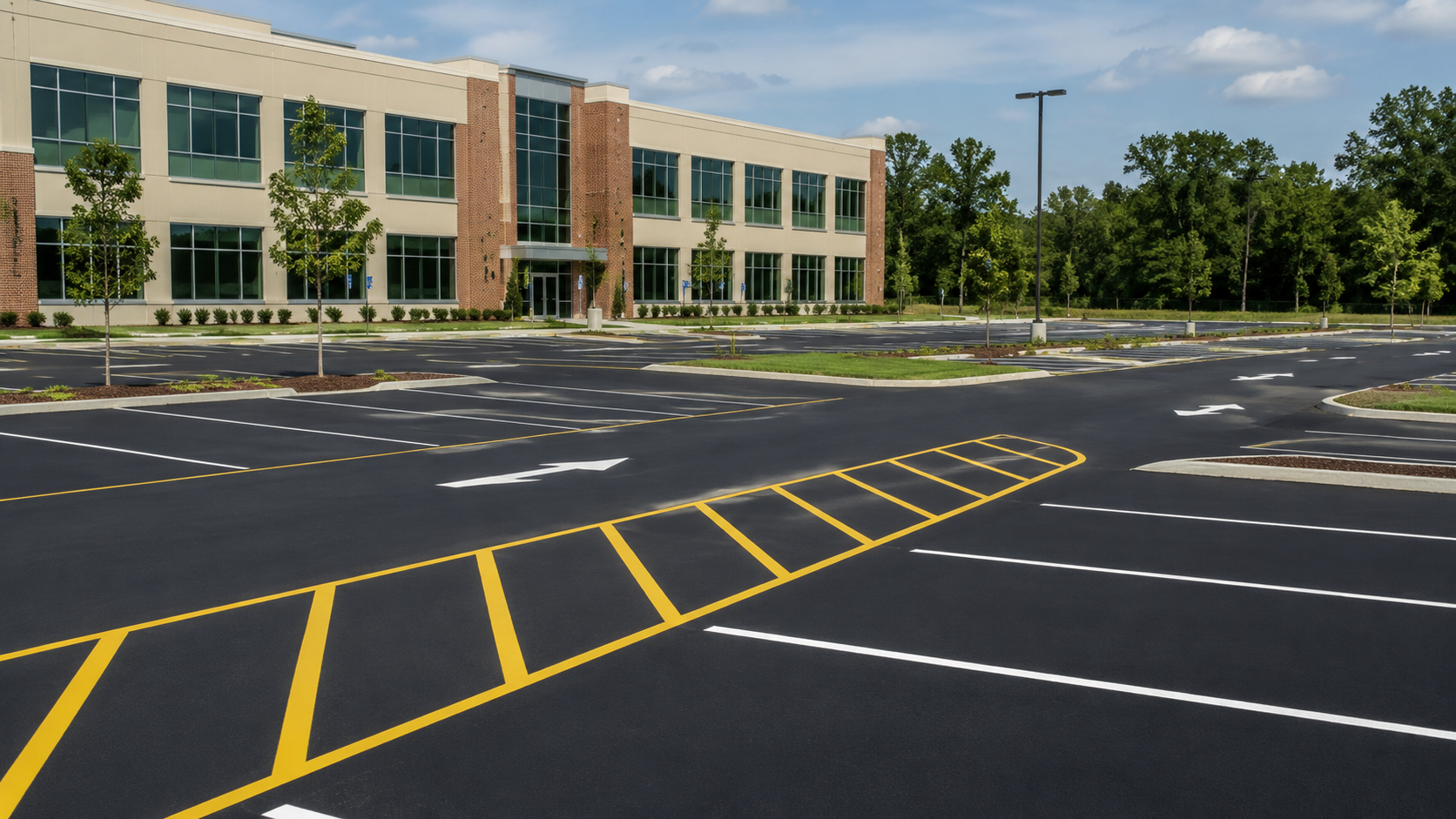
For parking lot striping, this growth pattern creates two distinct demand types that exist simultaneously in the Athens market. The first is new construction demand: freshly paved commercial lots that need their first-ever line layout — stalls, fire lanes, ADA markings, directional arrows — before the building opens. These are often retail pads, restaurant outparcels, medical offices, and distribution centers that have been built within the last five years in the bypass and interchange zones. The second is restripe demand on the existing commercial stock: properties built in the 2000s and early 2010s during the first wave of Toyota-era growth that are now hitting their second or third maintenance cycle. Lots sealcoated over the winter need lines repainted. Lots that haven't been touched since construction have lines that are fading toward invisibility after years of Limestone County summers.
The combination of these two demand types means Athens is consistently one of the stronger markets for striping work in the North Alabama region. If your property is in either category — newly paved or overdue for a refresh — the need is real and the timing matters for customer safety and property presentation.
Commercial property types in Athens and their specific striping needs
Athens' commercial base is more varied than its small-city profile might suggest. The US 72 corridor running through Athens and out toward the Huntsville metro carries a mix of national chain retail, local service businesses, strip centers, auto-related uses, and restaurant pads that collectively cover a broad range of lot sizes and configurations. These properties tend to be owner-managed or managed by regional property companies rather than the large institutional portfolios that dominate the Huntsville market — which means striping decisions are often made by a single owner or a small management team that may not be tracking restripe cycles as formally as a larger portfolio manager would.
The US 31 corridor running south from Athens toward Decatur and north toward the Tennessee line handles a different commercial mix — more distribution and light industrial in the southern stretch, more agricultural service and rural commercial going north. The I-65 interchange zone at Athens has attracted the larger-format retail and hospitality development that highway exchanges typically generate, including properties with larger surface lots that require systematic stall layout and well-marked pedestrian crosswalk networks.
Athens State University, located in the historic downtown, generates its own parking management context — campus lots, off-campus student-adjacent commercial properties, and the institutional lots that serve university events. Downtown Athens itself has a tight commercial core with on-street parking and smaller surface lots behind main street buildings, many of which predate modern ADA stall standards and have not been reconfigured since the properties were originally built. The downtown historic district commercial properties present a striping profile similar to older small-city downtowns across Alabama: irregular lot shapes, aging markings, and ADA configurations that need updating. Medical offices clustered near Athens-Limestone Hospital round out the commercial mix with their own compliance-sensitive marking requirements.
ADA and fire lane compliance for Athens commercial and civic properties
ADA accessible parking requirements apply to every commercial property open to the public in Athens and Limestone County, without exception for age of construction or property size. This is a point that catches many smaller Athens commercial property owners by surprise — the assumption that older buildings are grandfathered out of ADA compliance requirements is incorrect. While barrier removal obligations are calibrated to what is readily achievable for a given property, maintaining legible and correctly dimensioned ADA parking markings is considered a basic and low-cost barrier removal measure that all commercial properties are expected to address.
The practical compliance picture in Athens includes a significant inventory of properties along the US 72 corridor and in the downtown area where accessible stall markings have never been dimensioned to current standards, have faded to near-invisibility, or where the van-accessible access aisle is either absent or no longer distinguishable from an adjacent standard stall. The required stall widths — 8 feet for a standard accessible stall, 11 feet for a van-accessible stall — along with the required 5-foot and 8-foot access aisle widths are precise measurements that need to be marked correctly. Faded ISA symbols, missing blue background paint, and access aisles that have been painted over by vehicles parking in them over the years are all common deficiencies in the Athens older commercial market.
Fire lane compliance in Athens follows the same logic as any North Alabama city. Fire lanes must be kept clear to allow emergency vehicle access, and the only reliable way to enforce that requirement is through visible painted curbs and fire lane markings that give drivers unambiguous notice. Athens' commercial properties range from strip centers with a single drive aisle fire lane to larger retail and institutional lots with multi-leg fire lane networks. In all cases, fire lane paint that has faded to bare concrete or asphalt is effectively invisible — and an invisible fire lane is an occupied fire lane. Property managers at Athens commercial properties should be refreshing fire lane curb paint on the same cycle as the lot restripe, or more frequently for high-traffic areas. Property owners should verify final ADA requirements and fire lane standards with qualified professionals and the relevant local authorities having jurisdiction over the property.
Churches and institutions: the most common striping request in Limestone County
Limestone County has a high density of churches relative to its population — a characteristic it shares with most of rural and small-city North Alabama — and those churches collectively manage a large inventory of surface parking lots that were mostly built during the community growth surge of the 1990s and 2000s and have received minimal marking maintenance since. The typical Limestone County church lot profile is a 60–200 stall surface lot with asphalt that has been sealcoated at least once, lines that have faded significantly under 10–20 years of Alabama sun, no readable crosswalk at the main entrance or between the lot and the building, and ADA stalls that are present in roughly the right location but are no longer dimensioned or marked to current standards.
The operational stakes of faded church lot markings are higher than they might appear. On a Sunday morning when 300–600 vehicles arrive within a 20-minute window, clear directional arrows and defined stall lines are what prevent the lot from descending into a disorganized scrum where drivers improvise their own traffic patterns. Without visible directional flow markings, drivers entering from multiple points create head-on conflicts in drive aisles. Without clear stall lines, vehicles park at diagonal angles that consume 30% more space than properly striped stalls — which can leave a church lot that should hold 150 vehicles looking full at 100. Without a crosswalk at the main pedestrian entrance, the path from the lot to the building becomes an uncontrolled pedestrian-vehicle conflict zone on the busiest attendance days.
A full restripe with updated directional arrows, a fresh entrance crosswalk, and refreshed ADA markings is typically a half-day job for a mid-size church lot and runs $600–$1,500 depending on the number of stalls and additional markings needed. Athens-area churches that are approaching major attendance weeks — Easter, Christmas, community events — benefit from scheduling the restripe several weeks in advance rather than immediately before the peak period, to allow any layout adjustments to be evaluated during normal attendance before the high-traffic day arrives.
Scheduling and seasonal considerations for Athens and Limestone County properties
Athens sits in the same North Alabama climate zone as Huntsville and Madison, which means the same seasonal striping constraints apply. Traffic paint application requires surface temperatures above approximately 50°F for proper adhesion and cure — which in Limestone County means the practical outdoor striping season runs from roughly March through November, with the peak scheduling window being April through October. Extreme summer heat is less of a problem for paint adhesion than cold is, but surface temperatures above 120°F — which can occur on black asphalt in direct sun on a 95°F Alabama day — can cause traffic paint to cure too quickly at the surface while remaining soft underneath, leading to premature peeling. The standard practice is to stripe in the early morning during peak summer months to avoid the hottest surface temperatures.
The Athens commercial market has a seasonal scheduling pattern driven by the mix of new construction and restripe demand. Spring is consistently the busiest period for new layout work on properties that finished construction over the winter. Late summer and early fall, after the hottest weeks have passed but before temperatures drop, is the most common window for property managers to schedule restripes and ADA refreshes before year-end. Post-sealcoat restripes are distributed throughout the season, following whatever sealcoat schedule the property's maintenance contractor runs.
For the Toyota-area distribution and logistics facilities in Limestone County, scheduling constraints follow the facility's production calendar rather than the season. These properties often need to work around shift changes, receiving windows, and planned maintenance shutdowns. We coordinate with facility managers to find windows that minimize operational disruption while getting the work completed within the property's maintenance planning cycle. New commercial development along the I-65 interchange zone and US 72 bypass tends to have more scheduling flexibility — freshly paved lots without operating businesses can be striped at any convenient time before the tenant opens.