Harvest's commercial strip: what's here, who it serves, and why striping matters
Harvest is not a city — it has no municipal government, no city limits, and no city-level code enforcement. It is an unincorporated community in northern Madison County that has grown organically around the residential development patterns of the past three decades, driven partly by proximity to Redstone Arsenal and partly by the general northeast Huntsville growth corridor. The commercial development along Harvest Road and Old Railroad Bed Road reflects that residential service character: grocery stores, dollar stores, pharmacies, fast food, auto service, medical clinics, dentist offices, and the churches that anchor residential neighborhoods throughout North Alabama.
The properties serving this community have a distinctly neighborhood-commercial feel — smaller lots than the big-box retail zones on US 72 closer to Huntsville, more pedestrian-oriented in some sections, and built on a smaller scale that reflects the community they serve. But smaller scale doesn't mean lower maintenance standards. A strip center with 30 stalls that serves the weekly grocery and pharmacy needs of 500 households needs visible lot markings just as much as a 300-stall power center does. Faded stall lines invite drivers to invent their own parking patterns — which creates congestion at peak times, wastes lot capacity, and generates friction with tenants whose customers can't find clear spaces.
The Harvest commercial corridor also includes a significant volume of medical and professional office use. The Redstone Arsenal contractor population is a young-to-middle-age professional demographic with above-average healthcare utilization, and the medical offices and urgent care facilities along the Harvest Road commercial strip see consistent traffic. Medical office lots are among the most scrutinized for ADA compliance, because the patient population has a higher baseline rate of mobility needs and because medical settings generate a disproportionate share of ADA parking complaints relative to other commercial property types.
Strip centers and retail lots along Harvest Road and Old Railroad Bed Road
The strip centers and standalone retail properties that serve the Harvest community span roughly two generations of development. The older properties along the established Harvest Road corridor were built in the late 1990s and 2000s, when the community first hit the density thresholds that attract neighborhood retail investment. These lots have typically been sealcoated at least once, and many are now at or past the 10–15 year mark from their last formal restripe — well into the range where traffic paint on North Alabama asphalt has degraded from legible to marginal to invisible in the high-wear areas.
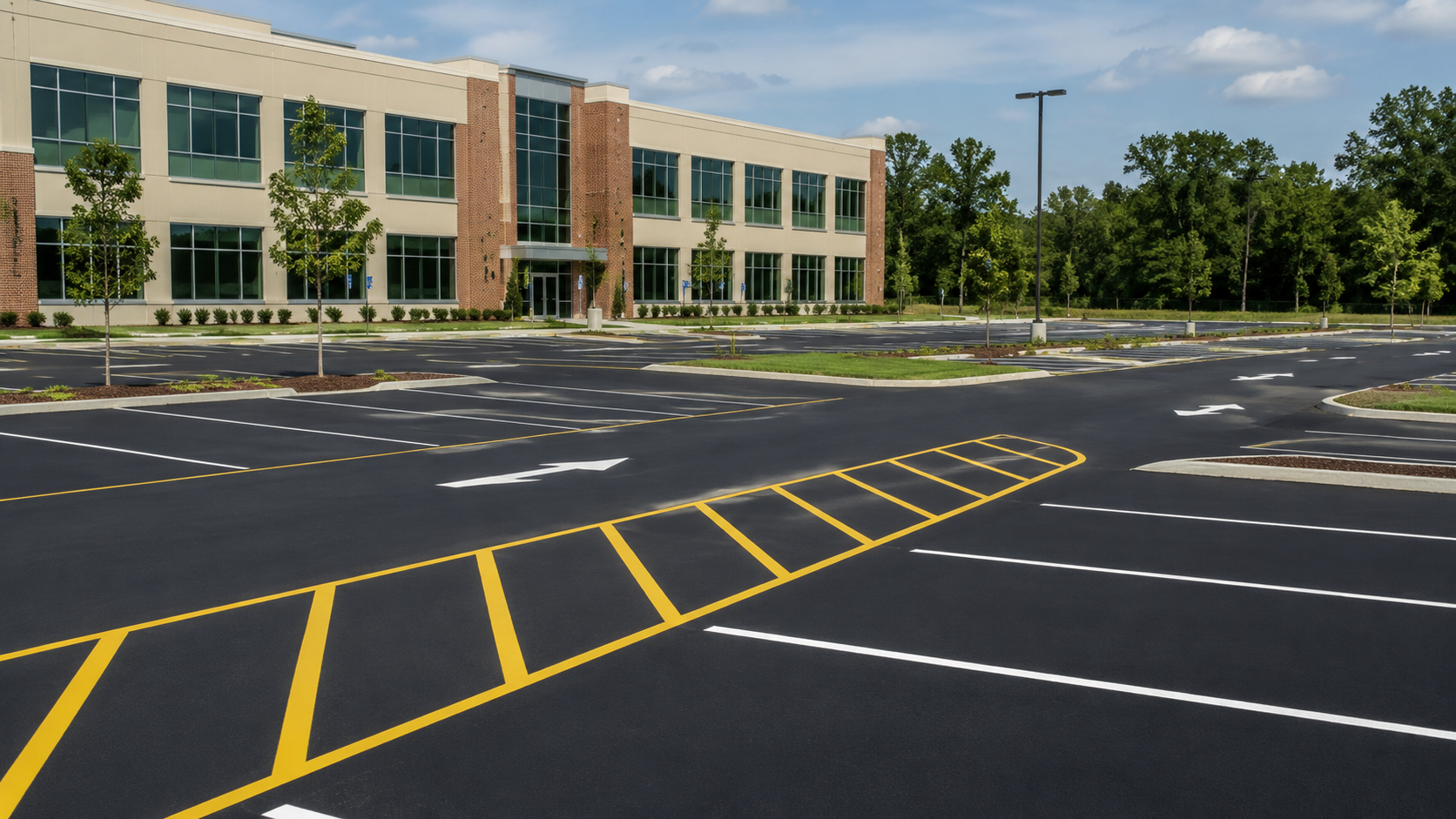
The newer commercial development along the Old Railroad Bed Road extension and the growing retail pads that have filled in around the Harvest Publix and adjacent anchors represent a more recent generation of properties that are just hitting their first restripe cycle. These lots often have the clean dark surface of a recent sealcoat with buried lines underneath — a strong signal that a restripe is the next maintenance step. When sealcoat is applied to a lot that still has visible lines, those lines come out completely black and undifferentiated from the rest of the surface. A fresh restripe on a newly sealcoated lot is one of the highest-visual-impact maintenance investments a Harvest retail property can make — the contrast between the dark sealcoated surface and fresh white or yellow lines is dramatic and immediately apparent to customers and tenants.
Restriping a typical Harvest strip center lot in the 25–60 stall range — including directional arrows at entry points, a fire lane or two, and an ADA stall refresh — is typically a half-day project. Most Harvest commercial properties can be scheduled for an early morning start on a weekday, with the lot dry and ready for normal business traffic by mid-morning.
Churches and community institutions in northern Madison County
Northern Madison County — Harvest, Toney, Hazel Green, and the surrounding unincorporated communities — has the church density typical of rural-transitioning-to-suburban North Alabama, with a large number of congregations that built or expanded their facilities during the residential growth waves of the 1990s and 2000s. The typical parking lot profile for a Harvest-area church is a 60–200 stall surface lot paved with asphalt that has been maintained for sealcoating but not for line marking, with paint that has faded progressively under 10–15 years of Alabama summers.
The practical consequences of faded church lot markings are most visible on high-attendance days. When stall lines are not clearly visible, drivers default to parking by proximity to other vehicles rather than within marked boundaries — which means stall utilization drops and the effective capacity of the lot is reduced at exactly the moments when capacity matters most. Easter Sunday, Christmas Eve, and community event days are the days when a faded lot reveals itself most clearly. A church that typically seats 400 and draws 500 for Easter can find its 150-stall lot functionally full at 100 vehicles when drivers are spreading out into unlined areas.
Beyond capacity, the pedestrian safety dimension of church lot markings matters in the Harvest context. Many northern Madison County church lots have main entrances that open directly from a public road or a shared drive aisle, and the absence of a painted crosswalk between the lot and the main building entrance means pedestrians and vehicles share an uncontrolled intersection on the busiest attendance days. A clearly painted crosswalk at the main building entrance, combined with a stop bar at the drive aisle, creates a defined and visually enforced pedestrian priority zone that reduces conflict and improves the guest experience for first-time visitors who are navigating the lot for the first time.
For Harvest churches with major attendance weeks on the calendar, scheduling the restripe six to eight weeks in advance is better than last-minute — it allows the newly laid out lot to be evaluated during a normal-attendance Sunday before the peak day, and it avoids the scheduling crunch that forms in the April window when every church in North Alabama wants a restripe at the same time.
Apartment complexes and the Redstone Arsenal contractor housing corridor
Harvest and the immediate northeast Madison County corridor have a significant multifamily housing market shaped by the Redstone Arsenal workforce. Defense contractors, military families, and support workers based at Redstone represent a stable, year-round rental demand base that has supported consistent apartment and townhome development in the Harvest area over the past two decades. The resulting apartment communities range from older garden-style complexes built in the late 1990s to newer townhome-style developments on larger parcels along the corridor.
Multifamily properties have specific parking lot marking requirements that differ from standard commercial lots. Assigned stall numbering is the most distinctive: many Harvest apartment communities use numbered stall assignments for residents, and when stall number markings fade, the assignment system effectively collapses. Residents park by habit rather than by assignment, visitors park in resident stalls, and the property management office generates complaints that can't be enforced because the stall boundaries and numbers aren't readable. Restoring stall numbers is one of the most operationally immediate reasons an apartment property manager schedules a restripe — the enforcement value of a numbered lot depends entirely on the markings being legible.
Fire lane compliance is the second major marking issue for Harvest apartment communities. Multi-building apartment complexes typically have fire lane requirements running through or around the main parking courts, and red-painted curbs are the standard marking method. Fire lane curbs that have faded from red to a dirty orange or pink are technically present but functionally compromised — residents who can't clearly read the marking may not recognize the zone as a fire lane. Property managers at Harvest apartment communities who are dealing with chronic fire lane blocking often find that repainting the curbs solves the problem more effectively than signage alone.
ADA accessible stall requirements apply to apartment community lots as well, though the specific count and configuration requirements differ from standard commercial properties. Common areas and leasing offices are covered by ADA Title III requirements, and the accessible stalls serving those areas need to be maintained to current marking standards. Scheduling apartment lot restripes for early morning on weekdays minimizes disruption to residents — most residents are off the lot by 8 AM, and a standard restripe is complete well before evening return traffic.
Pricing, scheduling, and what to expect for Harvest area striping work
One of the practical advantages of striping work in the Harvest corridor is the relative lack of the access and scheduling complexity that comes with higher-density commercial areas closer to downtown Huntsville. Harvest properties along Harvest Road and Old Railroad Bed Road have surface lots with straightforward access, low ambient traffic during early morning scheduling windows, and minimal shared-access conflicts with neighboring properties. A crew that starts at 6:30 AM on a weekday morning can typically complete a standard strip center restripe and be cleared before 10 AM, leaving the lot fully dry well before the peak lunch traffic window.
Pricing for Harvest parking lot striping runs comparable to Huntsville market rates — the short drive time from North Alabama contractors based in the city does not add a meaningful travel premium. For the most common Harvest commercial property types, the approximate price ranges are: small commercial or medical office lots in the 15–30 stall range, $400–$900 for a standard restripe; mid-size strip center lots in the 40–80 stall range with curb painting and full arrow layout, $1,000–$2,500; church lots with crosswalk and ADA updates, $600–$1,500; apartment complex lots with stall numbering and fire lane curb painting, $800–$2,500 depending on property size and stall count.
The biggest scheduling variable in the Harvest market is the post-sealcoat restripe queue. When a sealcoat contractor completes work on a Harvest strip center or church lot in the spring or summer, the property manager immediately needs a restripe scheduled. Demand for post-sealcoat restripes in the April–September window is high across North Alabama, and the Harvest corridor is no exception. Property managers who want to avoid a 2–3 week wait should book the restripe at the same time the sealcoat is contracted rather than waiting until the sealcoat work is done. We help coordinate that timing so the lot isn't sitting unmarked for an extended period between the sealcoat and restripe appointments.