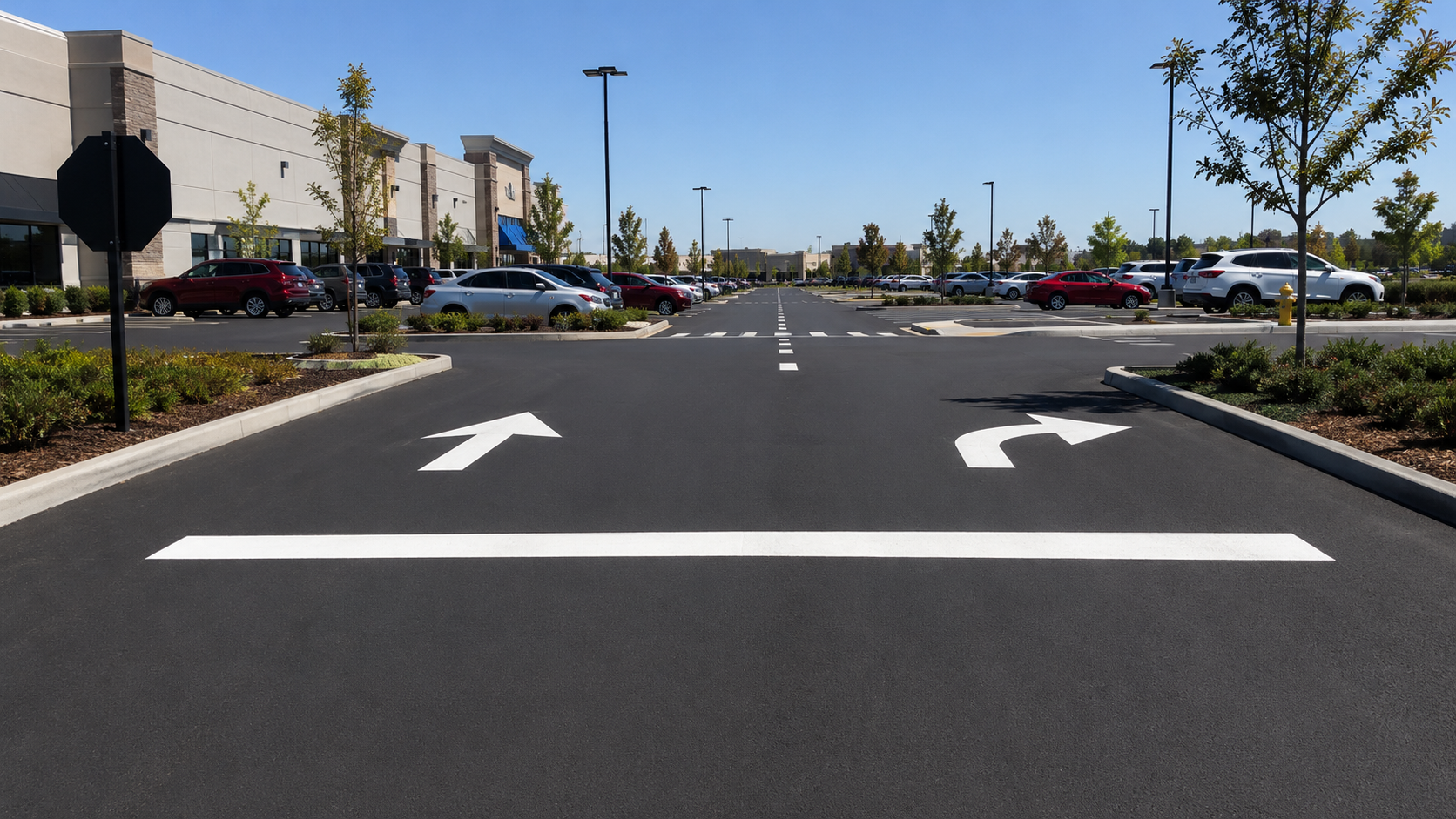
Directional Arrows and Why Traffic Flow Matters
Directional arrows are among the most impactful pavement markings on a commercial lot, yet they are often overlooked until the lot develops a congestion problem. In a one-way drive aisle, a clear directional arrow tells every driver entering the lane which direction to travel. Without it, drivers who are unfamiliar with the lot or who approach from the wrong end will create head-on conflicts that clog the aisle and frustrate everyone behind them. On larger lots with multiple circulation paths — common at retail centers on University Drive and Memorial Parkway or at distribution facilities along the I-565 corridor — a well-placed system of arrows turns a confusing maze of aisles into an intuitive one-way loop that keeps traffic moving. Two-way aisles also benefit from chevron or straight-ahead arrows that reinforce the center-of-lane expectation and reduce the tendency of drivers to wander toward the edges. For drive-through lanes at restaurants, pharmacies, and banks, arrows are essential: they define the queue path, separate drive-through traffic from general parking traffic, and prevent customers from accidentally entering the exit lane. Arrow placement should account for the driver’s sightline when turning into the aisle, not just the straightaway view, since a turning driver needs to see the arrow before the decision point, not after. When requesting a pavement marking estimate, describing your lot’s circulation pattern and any known congestion problems helps providers recommend arrow placement that addresses the actual flow issues rather than simply painting arrows at arbitrary intervals.
Crosswalks at Building Entrances and Pedestrian Paths
Pedestrian safety on commercial lots often gets less attention than vehicle traffic management, but a slip-and-fall or vehicle-pedestrian incident in an unmarked crossing area creates real problems for property owners. Painted crosswalks at building entrances signal to both pedestrians and drivers that this is a designated crossing point where foot traffic has priority. At retail and medical properties, crosswalks at main entrance doors, pharmacy pick-up lanes, and building-to-building paths between structures on the same campus are among the most frequently requested markings. Standard crosswalk designs use parallel white stripes extending across the drive aisle perpendicular to pedestrian travel direction. The stripes create a high-contrast visual that stands out from both the asphalt surface and the surrounding stall lines. On lots with high pedestrian volume — grocery anchors, big-box retailers, hospital campuses — a more robust crosswalk design with alternating filled bars can provide additional visibility. Schools and church campuses have their own pedestrian crossing needs, often with crosswalks connecting the main lot to the building entrance, a secondary parking area, or a drop-off lane. Apartment communities may need crosswalks at building lobby entrances or across internal drive aisles that residents use daily. When adding crosswalks, it helps to consider the pedestrian path from the most remote parking stall to the building entrance, not just the crossing immediately in front of the door.
Stop Bars, Fire Lane Stencils, and Regulatory Markings
Stop bars are simple but effective: a white or yellow painted bar across the travel lane tells the driver exactly where to stop before a pedestrian crossing, a drive exit onto a public road, or an internal intersection where cross-traffic has the right of way. Without a stop bar, drivers creep forward to different stopping points, reducing visibility for both the stopping driver and cross traffic. Adding stop bars at lot exits is particularly valuable on properties that exit onto busy commercial corridors where sight distance matters. Fire lane stencils are a regulatory marking category that requires careful attention. The most common format is NO PARKING FIRE LANE lettered in white or red paint along the drive lane adjacent to the building face. In some configurations, FIRE LANE alone is stenciled at intervals along the designated path. These markings work in conjunction with red curb paint and, in some jurisdictions, posted signage to communicate the restriction clearly. It is important for property owners to understand that fire lane markings are not purely aesthetic: they define the emergency access path that fire apparatus must be able to reach without obstruction. The specific placement, width, and marking requirements for fire lanes are determined by local fire code and should be confirmed with the local authority having jurisdiction before finalizing the layout. Pavement stenciling supports visibility but does not substitute for a layout that meets the actual fire code requirements for your property type.
Loading Zones, Reserved Spaces, and Custom Stencils
Beyond the standard markings that most lots share, pavement stenciling allows property owners to communicate a wide range of specific use designations directly on the pavement surface. Loading zones are commonly designated with LOADING ZONE or LOADING ONLY stencils, often paired with a time restriction notation, to reserve dock-adjacent or entrance-adjacent stalls for deliveries without blocking those spaces from use by customers during non-delivery periods. Reserved stalls for specific tenants, company vehicles, or management parking are marked with RESERVED stencils, sometimes paired with a suite number or tenant name. Visitor parking areas are marked with VISITOR or VISITOR PARKING to separate short-stay spaces from long-term tenant parking in mixed-use commercial properties and office parks. NO PARKING stencils are used to deter vehicles from occupying spaces that need to remain clear for operational, safety, or maintenance reasons — near trash enclosures, at utility access points, or at property entrances where parked vehicles would create a visibility hazard. Numbered stall markings are common in gated residential communities, structured parking, and assigned commercial lots where each stall has a specific owner or tenant. For condominium associations and office parks in the Huntsville area, numbered stalls eliminate disputes and make enforcement straightforward. Speed bump text markings — SPEED BUMP or SLOW painted in advance of a pavement feature — warn drivers before they reach the feature rather than after.
Where Each Marking Type Is Used Across Property Categories
The mix of pavement markings a property needs depends heavily on its use category. Retail shopping centers are among the most marking-intensive properties because they combine high vehicle turnover, pedestrian crossings, delivery activity, fire lane requirements, and accessible parking all in a single surface. A well-marked retail center typically needs arrows through drive aisles, stop bars at lot exits, crosswalks at anchor and junior tenant entrances, fire lane stenciling along the building face, loading zone designations near service areas, and accessible stall markings throughout. Medical office properties share many of these needs but place extra emphasis on accessible parking and crosswalk clarity because of their patient population. Warehouse and distribution properties prioritize directional arrows through drive lanes, dock staging zone boundaries, loading zone designations, and any applicable fire lane markings along building faces. Churches and community centers typically have straightforward stall layouts but benefit from clear arrows that guide large volumes of traffic in and out of the lot in a short window, along with crosswalk markings at the main entrance. Apartment communities need a combination of assigned-stall numbers, visitor parking designations, fire lane markings, and sometimes reserved handicap stalls. Schools have unique needs including drop-off zone markings, bus lane designations, crosswalks, and fire lane stenciling. Understanding the property type and how people actually move through the lot is the foundation of a useful pavement marking plan.
Requesting a Pavement Marking Estimate in Huntsville
Getting an accurate estimate for pavement marking services is easier when you can describe both the physical characteristics of the property and the specific markings you need. Start with the property type and address so the provider understands the context and can potentially review the lot using aerial imagery before the on-site visit. Describe the current condition of the lot: freshly paved, recently sealcoated, or an existing lot with aging markings. For each type of marking you need — arrows, stop bars, crosswalks, stencils, fire lane markings — try to estimate the quantity or describe the locations. A note like “one crosswalk at the main entrance, two at secondary entrances” or “directional arrows in four drive aisles” gives a provider a working scope to price against. If you have a site plan or a printed aerial image of the lot, sharing it with your estimate request significantly improves the accuracy of the initial quote. For complex properties with multiple tenants, special use areas, or phased marking needs, an on-site walkthrough before the formal estimate is often worthwhile. Describing any scheduling constraints — active business hours, night deliveries, events — also helps providers account for project timing. Huntsville Stripe Pros connects property owners with local providers who are familiar with the types of commercial properties and traffic patterns throughout the Huntsville metropolitan area.