
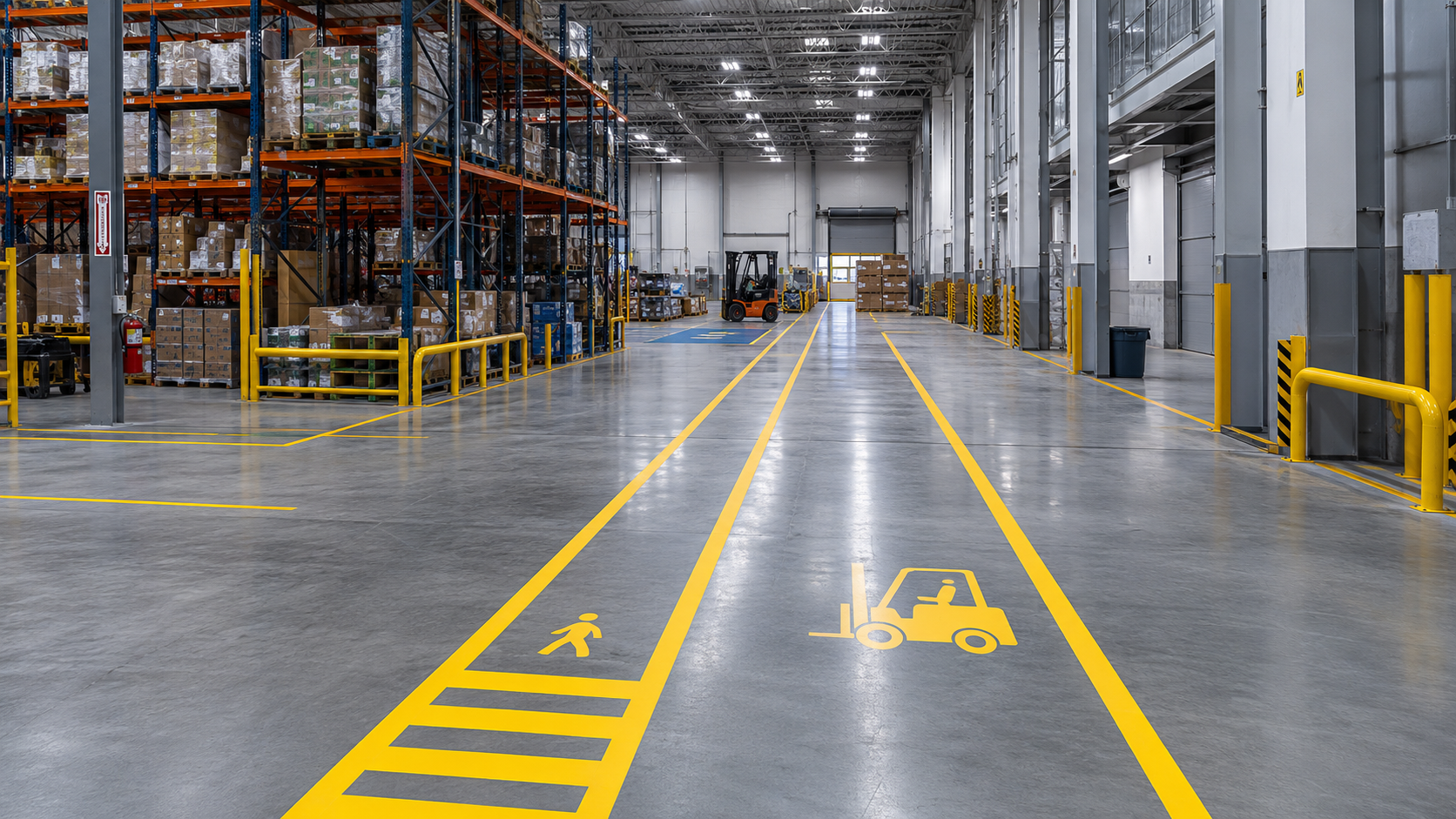
Why Warehouse Floor Markings Matter
In a busy warehouse or industrial facility, floor markings do more than organize space — they communicate movement, define hazards, separate pedestrian and equipment zones, and establish visual order that helps workers make fast, safe decisions. Clear markings for forklift travel lanes, pedestrian walkways, loading zones, and hazard areas reduce the guesswork that leads to near-misses and accidents.
For industrial and logistics facilities in Huntsville, Madison, Decatur, and Athens, AL, warehouse floor striping is an operational necessity — not just a cosmetic upgrade. This guide covers the main types of warehouse floor markings, the paint and materials used, how to plan a floor marking project, and when to schedule a refresh.
Types of Warehouse Floor Markings
A well-marked warehouse uses a consistent color system so any employee or visitor can immediately understand the layout without needing a guide. While specific color standards may vary by facility and industry, the following types of markings are common across most commercial and industrial warehouses:
- Forklift travel lanes. Wide painted lanes designate where powered industrial trucks are permitted to travel. Typically marked with yellow lines, these lanes help separate forklift routes from pedestrian areas and storage zones. Some facilities use single-line lanes; others use double lines with a marked centerline.
- Pedestrian walkways. Striped or solid paths for foot traffic are typically kept clearly separate from forklift lanes. Yellow and white are common colors; some facilities use diagonal hash marks or crosshatch patterns to reinforce pedestrian zones.
- Loading dock areas. The zone in front of loading doors where trucks are positioned, goods are staged, and forklifts operate simultaneously. Clear demarcation of where to stage pallets and where to avoid standing is important in these high-activity areas.
- Storage boundaries. Lines that define where product, shelving, or equipment should be positioned — and where floor space must remain clear. Keeping storage within marked boundaries maintains aisle widths required for forklift clearance and emergency egress.
- Hazard zones. Red or orange markings around electrical panels, fire suppression equipment, chemical storage, or other restricted areas signal that the space requires special attention or authorization.
- Directional arrows. One-way traffic flow, docking sequence arrows, and directional guidance markings help manage traffic in tight warehouse environments where forklifts and pedestrians share space.
- Safety perimeter lines. Lines around machines, assembly equipment, or robotic systems that indicate the safety boundary — the space that must remain clear while equipment is operating.
Color Standards for Warehouse Floor Markings
Many facilities use OSHA-aligned color conventions, though these are guidelines rather than universally mandated standards for every marking type. Common conventions include:
- Yellow: Traffic lanes, aisle markings, caution areas, physical hazards that may cause workers to trip, stumble, or fall
- White: Work area boundaries, finished goods storage, general information markings
- Red: Fire safety equipment locations, danger areas, emergency stop zones
- Orange: Equipment safety boundaries, machinery perimeters
- Blue: Informational markings, cold storage or special areas
- Green: First aid stations, safety equipment, egress pathways
Establishing and maintaining a consistent color system throughout your facility makes the markings more intuitive and reduces the need for verbal instruction when onboarding new employees or hosting visitors and auditors. Discuss your color system preferences with your striping contractor before work begins.
Paint and Coating Options for Industrial Floors
Outdoor parking lot striping and warehouse floor striping use different materials because the conditions are different. Interior concrete floors in warehouses are subject to forklift traffic, pallet jacks, cleaning equipment, moisture, and chemical exposure — conditions that standard traffic paint is not designed to withstand long-term.
The most common options for warehouse floor coatings include:
- Epoxy paint. The most widely used solution for industrial floors. Epoxy bonds chemically to concrete and cures to a hard, durable surface that resists abrasion, most chemicals, and forklift wear. Available in a full range of colors. Requires proper surface preparation — typically grinding or shot blasting — for good adhesion.
- Polyurethane coatings. More flexible than epoxy and more resistant to UV exposure and thermal cycling. Often used as a topcoat over epoxy in areas subject to temperature extremes or outdoor exposure.
- Water-based traffic paint. Faster application and lower cost than epoxy. Appropriate for lighter-traffic areas or where the floor surface has already been treated. Not as durable as epoxy in high-forklift-traffic zones.
- Adhesive floor tape. A non-paint alternative for temporary or frequently changed markings. Easier to remove and reposition than painted lines. Appropriate for areas where the layout changes regularly or where painting is not feasible.
The right choice for your facility depends on the floor surface condition, the intensity of forklift and equipment traffic, whether the floor is currently sealed or coated, and your target maintenance interval. A contractor experienced in warehouse floor striping can assess your surface and recommend the appropriate system.
Scheduling Around Operations
One of the most important planning considerations for warehouse floor striping is minimizing operational disruption. Unlike outdoor parking lots, warehouse floors are typically in use around the clock or across multiple shifts, with equipment and inventory occupying the floor space the crew needs to access. This requires more advance planning than a standard parking lot project.
Effective planning steps include:
- Section the work. If the full floor cannot be taken offline at once, divide the project into sections that can be cleared, striped, and cured in sequence — ideally overnight or on weekends.
- Coordinate with shift supervisors. Understand which areas are lowest-traffic during which hours. Many facilities schedule floor striping during a planned shutdown, inventory count, or holiday weekend.
- Plan product staging. Pallets, shelving, and inventory stored on the floor need to be moved before the contractor can stripe. Work with your team to plan staging areas in advance.
- Allow for cure time. Epoxy paint requires 24 hours or more before full heavy-equipment traffic should resume, depending on the product and conditions. Water-based paint cures faster but should still be allowed to dry fully before forklift traffic returns.
- Post signage. Mark wet paint areas clearly and communicate to all shifts when and where the freshly striped sections can be used again.
When to Refresh Warehouse Floor Markings
Warehouse floor markings face more demanding conditions than outdoor parking lot paint. Forklift tires, pallet jacks, cleaning equipment, and foot traffic in a busy facility can wear down floor markings faster than exterior asphalt lines. The right refresh interval depends on your specific traffic levels and coating type, but watch for the following signs that markings need attention:
- Lane boundaries are fading and difficult to see in normal facility lighting
- Pedestrian walkways are partially obscured or worn through
- Safety perimeter lines around equipment are no longer clearly visible
- Employees or contractors are asking which zones are pedestrian vs. forklift
- An upcoming safety audit, insurance inspection, or regulatory visit is scheduled
- New equipment has been installed and requires a new safety perimeter
- The facility layout has been reconfigured and old markings no longer reflect current flow
Request a Warehouse Floor Striping Estimate in Huntsville
If your Huntsville, Decatur, or Madison industrial facility is due for new or refreshed floor markings, the best starting point is an estimate request. Include the floor type (concrete, epoxy-coated, sealed), approximate square footage or facility size, the types of markings needed, and your operational schedule constraints. Photos of your current floor are also helpful.
Visit our warehouse floor striping page for more information, or submit an estimate request from the homepage.