Why Curb Paint Fades Faster Than Flat Lot Markings
Curb surfaces take more abuse than flat pavement markings and tend to deteriorate faster for several reasons. The vertical face of a curb is directly exposed to ultraviolet radiation from multiple angles throughout the day, which breaks down paint pigment more aggressively than the horizontal sun exposure flat stall lines receive. Curb faces are also subject to direct vehicle contact from tire scrub, door contact from drivers misjudging their clearance, and snow plow blade contact during winter clearing operations. Water pools at the base of curbs during rain events and during lot washing, creating sustained moisture contact that can cause paint to lift and peel. The curb-to-pavement joint is particularly vulnerable because water infiltrates at that seam and works its way under the paint film. For fire lane and no-parking curbs, paint condition is a practical concern beyond aesthetics: a driver who cannot see the curb color clearly may not recognize the restriction and park in a zone that needs to remain clear for emergency vehicle access or loading operations. Property managers at retail centers, medical buildings, and apartment complexes along busy Huntsville corridors should check curb paint condition at least once a year and schedule repainting before curbs fade to the point where the color is no longer clearly identifiable from a vehicle at normal approach speed.
Red Curb Fire Lanes: Requirements and Painting
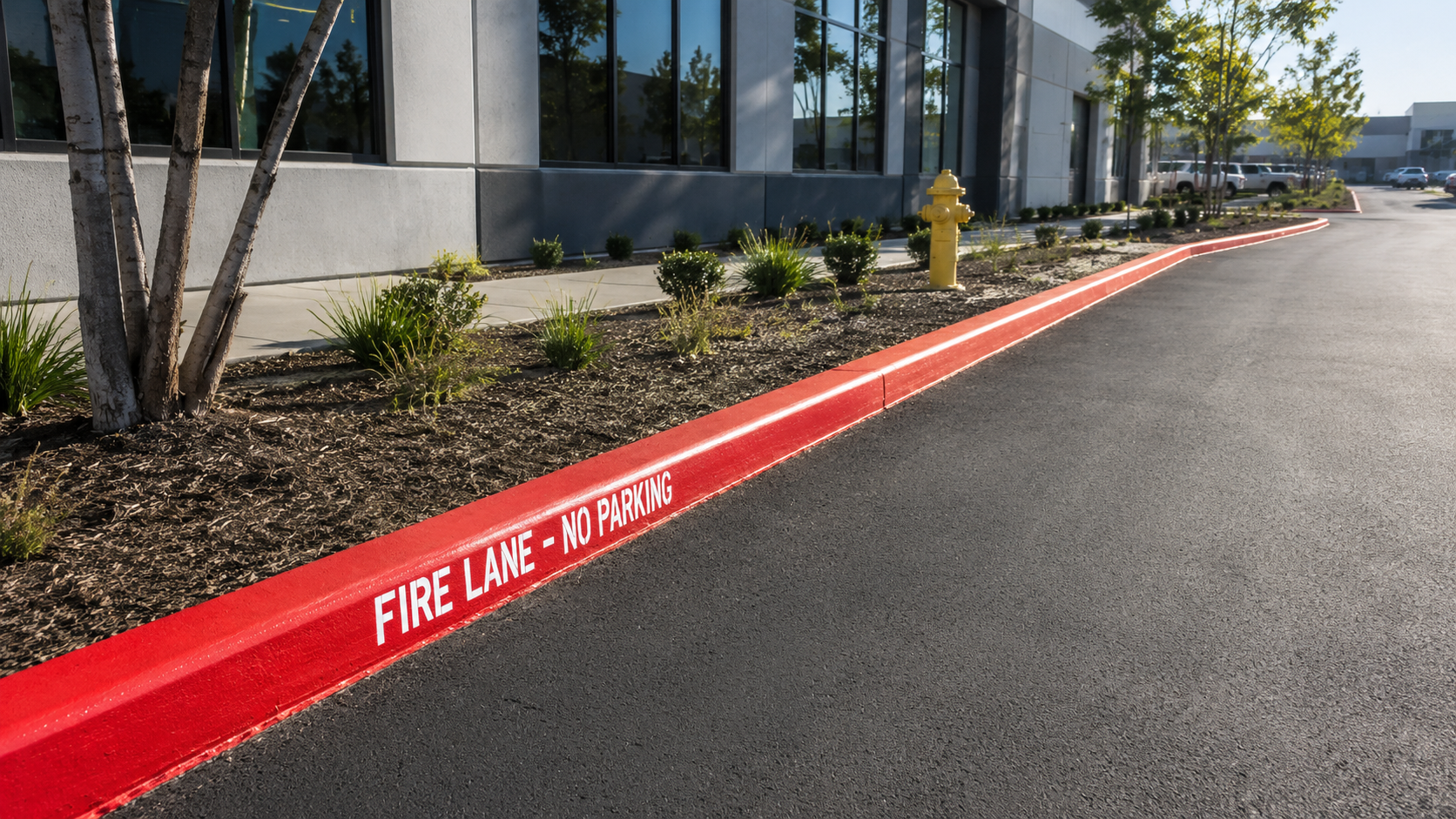
Red curb paint is the most widely recognized marking for fire lane designations at commercial properties. Along the building face, red curbs signal to drivers that parking here is prohibited at all times because the zone must remain clear for fire apparatus access. On properties with interior drive aisles that serve as fire apparatus access roads, red curb may extend along the full length of the restricted lane. The combination of red curb paint and NO PARKING FIRE LANE stenciling on either the curb face or the pavement surface provides two layers of visual communication: the color cues the restriction from a distance as the driver approaches, and the text stencil confirms it at close range. Fire lane curb painting and stenciling must follow the requirements established by the local authority having jurisdiction, which in the Huntsville area means working within the framework of the local fire marshal and applicable fire codes. The placement, width, minimum length, and specific marking requirements for fire lanes are not uniform across all property types and locations. A fire lane layout that was acceptable for a strip mall may not satisfy requirements for a hospital campus or a big-box retail anchor. Property owners planning new fire lane markings, relocating existing lanes, or refreshing old markings after a layout change should confirm the current requirements with the local fire marshal or code official before finalizing the paint layout. Repainting a fire lane to match the original position and dimensions is generally a straightforward maintenance task; any changes to fire lane location or extent are layout decisions that warrant a code review first.
Yellow Curbs, No-Parking Zones, and Loading Areas
Yellow curb paint is commonly used to designate no-parking or restricted-parking zones that are not fire lane designations. At commercial properties, yellow curbs often appear at property entrances and exit points where parked vehicles would obstruct driver sight lines, at drive-through queue entry points where a parked vehicle would block the lane, along segments of the lot perimeter where stopping is discouraged but not fire-code-critical, and at utility access points or equipment pads that need to remain accessible to service personnel. In some jurisdictions and property contexts, yellow curbs also designate loading zones or time-limited stopping areas, though white is the more common convention for active loading zones. Property managers should use the color convention appropriate for the specific restriction and consistent with local practice to avoid confusing drivers who rely on color expectations from other properties they visit. Loading zones are frequently marked with yellow or white curb paint combined with a LOADING ZONE text stencil on the curb face or pavement surface adjacent to the curb. Time restrictions can be added with stenciled hour ranges if the zone is only a loading area during specified delivery windows. Active loading dock areas at the rear of commercial buildings often use a combination of curb paint, bollards, and pavement stenciling to define the dock approach and prevent customer vehicles from entering the dock area.
ADA Blue Curb Cuts and Accessible Drop-Off Areas
Blue curb paint is used at accessible parking areas and curb cut locations to reinforce the accessible designation at the ground level. While the primary accessible parking designation occurs through pavement markings (blue surface paint on the stall and access aisle) and vertical signage, blue curb paint at the curb transition adjacent to accessible spaces provides an additional visual cue that helps orient both the accessible space user and other drivers in the lot. At designated accessible passenger drop-off zones, blue curb or blue pavement markings combined with appropriate stenciling signal that the zone is intended for accessible passenger loading and unloading. This is distinct from a general passenger loading zone and is important for properties like medical clinics, senior living facilities, and community centers where accessible drop-off access is a routine need. Blue curb paint at curb cuts along accessible routes reinforces the visual connection between the accessible parking stall, the access aisle, and the accessible path of travel leading to the building entrance. For property owners refreshing accessible parking areas as part of a broader lot restripe, including blue curb painting at relevant curb transitions and drop-off zones as part of the project scope ensures that the full accessible path of travel is visually coherent. As with all accessible parking decisions, property owners should verify the specific requirements for their facility type with a qualified professional. This page provides general information and not legal or compliance advice.
Combining Curb Work with a Full Lot Restripe
Curb painting is most cost-efficient when bundled with a parking lot restripe or pavement marking project rather than scheduled as a standalone job. When the striping crew is already on-site with equipment set up and paint mixed, adding curb painting to the scope requires relatively modest additional time and cost compared to mobilizing separately for curb work alone. The workflow also benefits from coordination: after pavement markings are completed, fresh curb paint along fire lanes and no-parking zones creates a visually consistent result where the curb and pavement restrictions reinforce each other at full brightness simultaneously. For properties that have been through multiple restripe cycles without a full curb refresh, the contrast between bright new stall lines and faded curb paint can make the curb restrictions look even worse by comparison. Addressing both in the same project eliminates that visual inconsistency. For properties undergoing a post-sealcoat restripe, curb painting should be factored into the scope from the start: sealcoat typically gets applied over the curb-to-pavement transition and may partially coat the lower portion of the curb, which means the curb paint refresh happens naturally as part of getting the full surface back to a clean, finished condition. When requesting an estimate that includes curb painting, describing the linear footage of curbs to be painted, the colors needed, and whether stenciling is required on the curb face gives the provider the information needed to price the full scope accurately.
Fire Marshal Context and Pre-Inspection Curb Refresh
Commercial properties in Huntsville are subject to periodic fire marshal inspections, and one of the items that inspectors check is the condition and placement of fire lane markings. A fire lane with badly faded curb paint and illegible stenciling may generate a deficiency notice that requires correction within a defined time frame. Proactive curb maintenance ahead of known inspection cycles is a straightforward way to avoid last-minute scrambles. Properties that have recently changed ownership, undergone renovations, or changed their primary use category may also trigger a re-inspection of fire lane adequacy. New owners inheriting a property with aging curb markings should consider a full curb and fire lane assessment as part of their initial property review, both to understand what they have and to establish a documented baseline for maintenance. When fire lane markings are questioned during an inspection, the path forward involves confirming with the fire marshal what specific marking requirements apply to the property, determining whether the existing layout meets those requirements, and then coordinating the painting work to address any deficiencies identified. The painting itself is the straightforward part; the layout and placement decisions are where code review matters. Huntsville We connect you with certified contractors who help property owners connect with local providers who are experienced with commercial curb painting on properties ranging from small neighborhood retail to large medical campuses, but the final fire lane layout decisions should always be confirmed with the applicable authority before paint is applied.