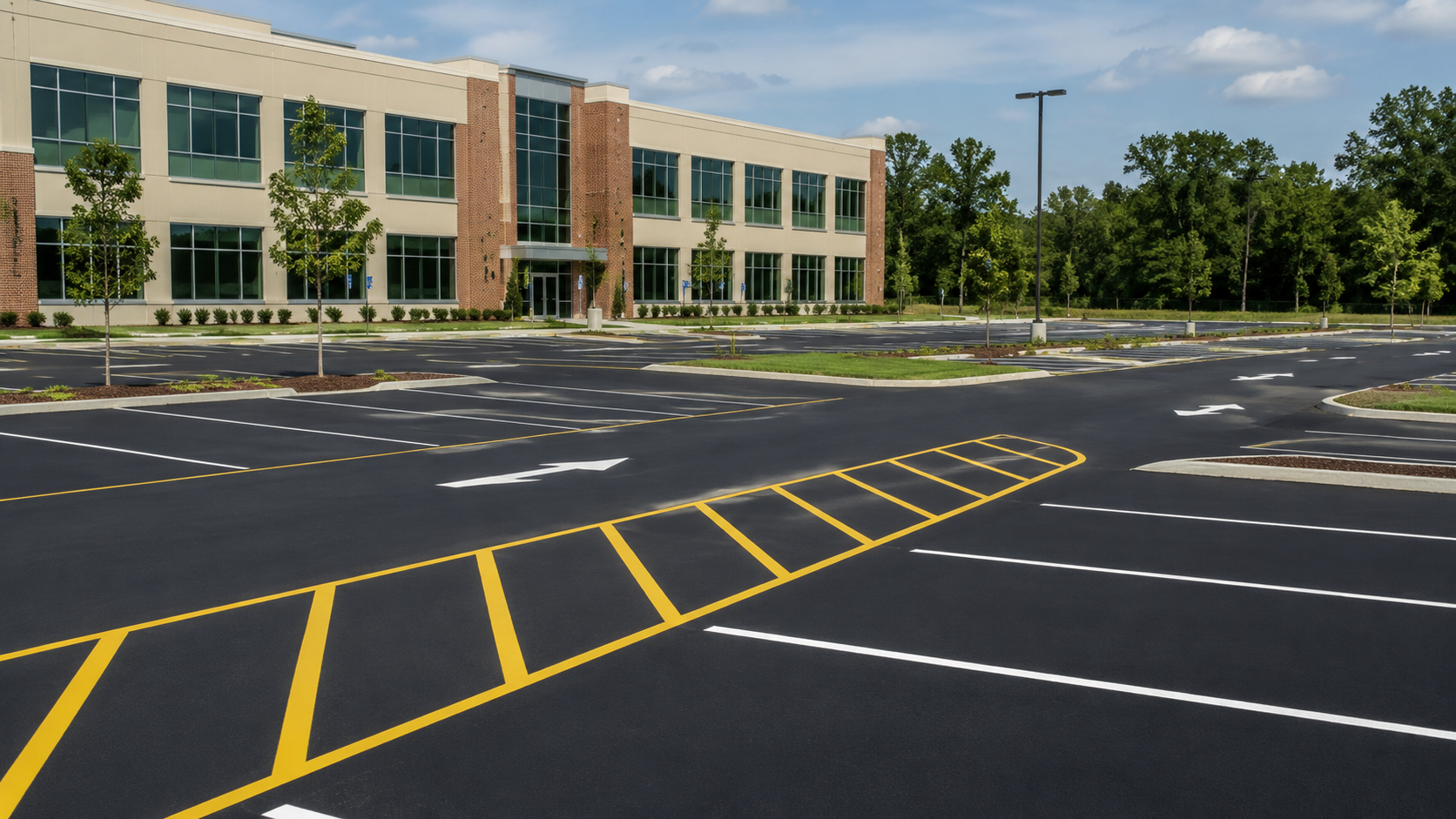
Decatur's industrial base and the floor marking demand it drives
Decatur has a concentration of heavy industrial employers that is unusual for a city its size. 3M, Nucor Steel, Daikin, and dozens of chemical, food processing, and manufacturing operations all maintain large facilities in Morgan County, many of them clustered in the industrial parks along I-65 and Highway 31 near the Tennessee River port. Every one of those facilities has warehouse and production floor marking requirements that go well beyond painting stall lines in a parking lot. Forklift travel lanes, pedestrian walkways, staging area boundaries, dock approach zones, restricted access perimeters, and safety equipment identification markings are all part of the floor marking scope at a functioning industrial facility.
OSHA 29 CFR 1910.22 requires that permanent aisles and passageways in general industry workplaces be appropriately marked, and OSHA inspectors in Alabama's industrial sector consistently flag unmarked or faded floor markings during routine compliance audits. The regulatory exposure is real: unmarked or illegible aisle markings have supported OSHA citations in manufacturing environments, and many Decatur facilities also face third-party safety audits from customers, insurers, and parent companies that evaluate floor marking condition as a visible proxy for overall safety culture. A floor marking project is one of the most defensible maintenance investments a Decatur industrial facility manager can make before an audit cycle.
Beyond regulatory compliance, floor marking in an active industrial facility serves a direct operational function. Clear forklift lanes reduce near-miss incidents between powered industrial vehicles and pedestrians. Visible dock zone boundaries prevent staging errors that cause bottlenecks during shift changes. Color-coded safety equipment locations let workers find fire extinguishers and first-aid stations without delay. The economic case for current, legible floor markings in a Decatur manufacturing or distribution environment is straightforward — and when markings fade or become unreadable, the cost of repainting is small relative to the risk exposure of deferring it. Decatur's industrial facilities that haven't refreshed floor markings in three or more years should treat the project as overdue.
Retail and commercial corridors: Sixth Avenue, Beltline Road, and the historic downtown
Decatur's commercial corridors span a wide range of property ages and conditions, which translates directly into a range of striping needs. The Beltline Road area and the Sixth Avenue SW corridor carry most of the city's active retail traffic — national chains, regional service businesses, grocery-anchored centers, and the auto-related uses that tend to concentrate along Alabama commercial arterials. Many of these lots were originally striped with alkyd traffic paint at the time of their last resurfacing or major sealcoat job, which for a significant portion of the Decatur retail market means the original lines are now 5–10 years old or older. At that age, the combination of UV fading, traffic wear at entry points, and the slow dissolution of paint adhesion leaves lots with lines that are barely visible to drivers — particularly in overcast or rainy conditions.
Decatur's historic downtown commercial district presents a different set of conditions. Bank Street and the older blocks near the Morgan County Courthouse have commercial and civic properties that in many cases predate current ADA parking requirements and have never been retrofitted with compliant accessible stall configurations. The Morgan County seat brings significant government and civic property into the mix — county buildings, courthouses, public parking lots — all of which have ADA obligations and restriping cycles that need to be managed. Older downtown properties often have lots with irregular shapes, narrow stalls that were laid out before current vehicle sizes, and directional flow patterns that made sense in a lower-traffic era but now create conflict at peak times.
Bridge Street area commercial development adds a newer commercial layer to Decatur's property mix — strip centers and pad sites built within the last 10–15 years that are now reaching their first major restripe cycle. Fresh sealcoats on these lots will completely cover existing lines, making a coordinated restripe the necessary next step. We serve Decatur retail and commercial property managers across all three of these corridor profiles: the aging Sixth Avenue and Beltline Road stock, the historic downtown civic and commercial properties, and the newer Bridge Street corridor development.
ADA and fire lane compliance for Decatur commercial properties
ADA accessible parking requirements apply to all commercial properties open to the public in Decatur, regardless of when the building was originally constructed or when it was last renovated. The ADA does not grandfather older properties out of compliance obligations when they are in active commercial use — and this is a point that catches many Decatur property owners off guard when they receive a complaint or are preparing a property for sale or refinancing. The requirements cover the number of accessible stalls relative to total lot capacity, minimum stall widths (8 feet for standard accessible, 11 feet for van-accessible), required access aisle widths (5 feet standard, 8 feet van-accessible), surface slope limits, and the International Symbol of Accessibility on each designated stall.
Decatur has a large inventory of commercial properties built during the 1970s through 1990s — particularly along the older portions of Sixth Avenue SW and in the downtown district — where accessible stall markings were added informally, never brought up to current dimensional standards, or have faded to the point of being unenforceable and unrecognizable. A fresh ADA striping pass on these properties corrects all of these issues at once: correctly dimensioned stalls, properly marked access aisles with cross-hatch or diagonal line patterns, readable symbols, and blue background paint where required. The investment is typically modest relative to the compliance and liability exposure of leaving non-conforming markings in place.
Fire lane compliance is the other major marking category for Decatur commercial property managers. Fire lanes must be kept clear at all times to allow emergency vehicle access, and the primary enforcement mechanism is visible painted curbs and fire lane markings that put drivers on notice. Faded or absent fire lane markings invite routine parking in those zones, which creates liability for property owners and potential emergency access issues. Morgan County fire authorities inspect commercial properties, and visible fire lane markings are a basic expectation. Decatur properties that have not refreshed their fire lane curb painting in the past 3–5 years are likely operating with markings that are no longer readable enough to serve their function. Property owners should verify final ADA requirements and fire lane standards with qualified professionals and local authorities having jurisdiction.
Scheduling striping around Decatur industrial and commercial operations
The biggest logistical challenge for striping work at Decatur industrial facilities is working around continuous operations. Chemical plants, food processing lines, Nucor Steel production, and other heavy manufacturing operations in the Morgan County industrial corridor don't pause for parking lot or floor marking maintenance — and in many cases, a full facility shutdown would cost far more than the striping project itself. Scheduling around active operations requires a different approach than a standard commercial lot restripe.
For exterior parking lots at industrial facilities, the typical solution is off-shift scheduling — identifying which sections of the lot can be coned off during a night shift, weekend, or planned maintenance window, and sequencing the work so that the facility's shift change and parking demand patterns are respected. The goal is to have each painted section fully dry before the next vehicle wave arrives. Traffic paint on asphalt is typically tack-free within 30 minutes under normal North Alabama conditions and hard-dry within a few hours, which makes overnight sequencing practical for most facility lots.
Interior warehouse floor marking in operating facilities is more complex. The work typically has to happen in sections — one aisle zone at a time — with forklifts and pedestrian traffic rerouted around the active marking area. For large Decatur distribution centers and manufacturing plants, this may mean spreading the project across multiple overnight sessions or a weekend maintenance window. Epoxy-based floor coatings, which are common in chemical and food processing environments for durability reasons, have longer cure times than traffic paint and generally require a full shutdown window rather than section-by-section scheduling.
For Decatur's retail and commercial properties on the Beltline Road and Sixth Avenue corridors, scheduling is simpler but still requires coordination. Early morning starts — typically 6–8 AM on a weekday — allow the work to be completed before peak business hours. Most commercial lot restripes in the 30–80 stall range take 2–4 hours, which means the lot is dry and ready for normal traffic by mid-morning. Church lots and Morgan County civic properties are typically scheduled on weekday mornings to avoid Sunday service conflicts and county business hour peaks.
Decatur Morgan Hospital, medical campuses, and government properties
Decatur Morgan Hospital and the network of medical offices, specialist clinics, and outpatient facilities that have grown up around it represent one of the most compliance-sensitive environments for parking lot management in the city. Medical properties are scrutinized more closely for ADA compliance than most other commercial property types because their patient population has a higher baseline rate of mobility-related needs. The practical consequence is that ADA accessible stall deficiencies at a medical property — stalls that are too narrow, access aisles that have faded, van-accessible designations that are missing or unclear — carry a higher probability of generating complaints and formal accommodation requests than the same deficiencies at a retail property.
Medical campus lots in Decatur also tend to have more complex layout needs than straightforward retail properties. Multi-building campuses require pedestrian crosswalk networks connecting parking areas to building entrances. Patient drop-off zones, ambulance access routes, and emergency entrance areas need to be clearly delineated and kept current as facility expansions change traffic patterns. Staff parking sections, visitor sections, and accessible stall clusters each need to be laid out and marked consistently so that patients navigating the campus for the first time — often under stress — can orient themselves quickly.
Morgan County government properties — the courthouse complex, county administrative buildings, public parking facilities near the downtown civic core — have their own striping and marking obligations. Municipal and county properties are subject to ADA Title II requirements, which apply to government entities regardless of size, and public lots that serve government buildings need to maintain accessible stall ratios, readable markings, and compliant access aisles on a consistent maintenance schedule. The Morgan County seat brings a cluster of these civic properties into a relatively compact downtown area, and coordinating restripe cycles across them is a project that benefits from a contractor with experience in government property work. Property owners and managers should verify final ADA requirements and applicable standards with qualified professionals and the relevant local authorities.