
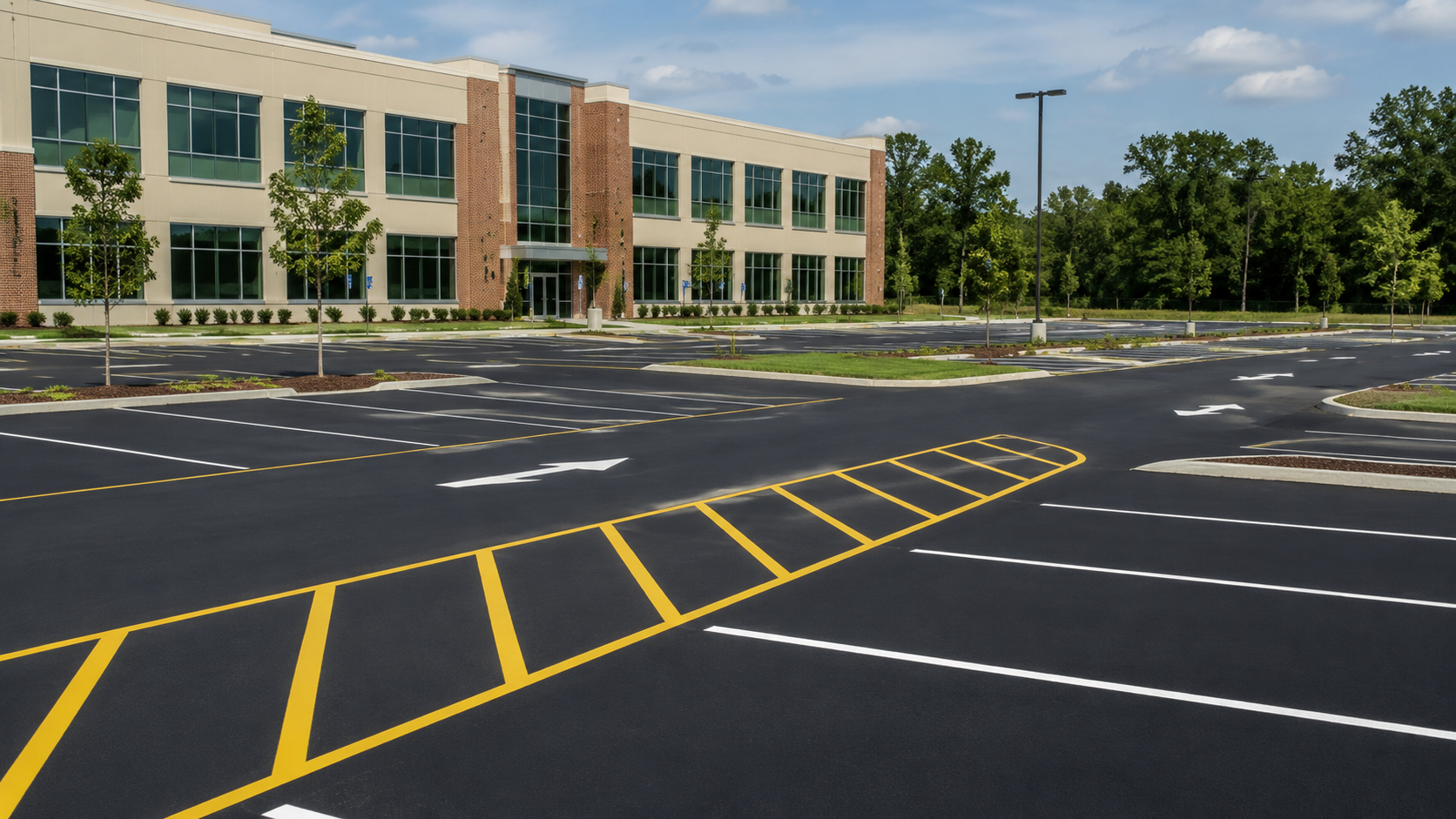
The Right Sequence Matters More Than You Think
Getting a parking lot repaved is a significant investment. After watching a paving crew spend days laying fresh asphalt across your commercial property, the natural instinct is to get the lot looking complete as quickly as possible — striped, open for business, and ready for customers or tenants. That instinct can cost you. Striping fresh asphalt too soon is one of the most common and most avoidable mistakes in commercial parking lot maintenance. This guide covers what you need to know about the sequence, timing, and coordination involved in striping after repaving.
How Long to Wait Before Striping New Asphalt
The standard industry recommendation is to wait a minimum of 30 days after new asphalt is placed before applying traffic paint. In practice, 30 days is the floor — the true minimum under good conditions. Many contractors recommend 60–90 days for full cure in Alabama's climate, particularly for work done in summer months.
Here's why the wait matters. Fresh asphalt contains volatile compounds — petroleum-based solvents and oils — that off-gas from the surface as the pavement cures. While this process is happening, the surface is still chemically active. Paint applied to actively off-gassing asphalt does not bond properly to the surface. Instead of adhering to the aggregate and binder in the pavement, the paint sits on top of a surface that continues to release gases through it, resulting in adhesion failure — paint that peels, bubbles, or wears away in a fraction of the time that properly adhered paint would last.
Temperature affects cure rate significantly. Asphalt laid in the cooler months of spring or fall in North Alabama cures more slowly than asphalt laid in July or August. Counterintuitively, summer is harder on fresh asphalt in a different way — high temperatures keep the pavement's surface pliable longer, and the oils take longer to fully off-gas in extreme heat. A 30-day wait in October may be sufficient; a 30-day wait in August may not. A professional striping contractor who works the Huntsville market will know to test the surface before painting, not just count calendar days.
The practical test: press a firm thumb into the surface of the asphalt. New, uncured asphalt will leave an impression. Properly cured asphalt will not. If your thumb leaves a mark, the surface is not ready for striping. Many contractors also use a solvent test — applying a small amount of mineral spirits to the surface — to assess off-gassing activity before committing to a full stripe job.
Why Striping Too Early Fails
If you've ever seen a freshly paved commercial lot where the striping started peeling and fading within 3–6 months, premature application on uncured asphalt is the most likely cause. The failure mode is specific and recognizable: the paint doesn't wear uniformly the way properly bonded paint does. Instead, it peels in sheets, lifts at edges, or develops a hazy, dull appearance across the line surface within the first few months. Once this happens, the lot needs to be restriped — and the cost of the premature stripe was entirely wasted.
Beyond paint adhesion, there's another reason to wait: pavement consolidation. New asphalt continues to compact and settle under traffic load for weeks after placement. Striping during the settlement phase means the lines were applied to a surface that isn't yet in its final position. Drive aisles and stalls that look perfectly aligned when fresh may be slightly distorted after the pavement has fully settled under its first months of traffic. Waiting the full cure period before striping ensures the layout is applied to a stable surface.
Who Is Responsible for Coordinating the Striping After Repaving?
This is a question that creates confusion — and sometimes disputes — between property owners, paving contractors, and striping contractors. Let's be direct: the paving contractor is responsible for the pavement. The striping contractor is responsible for the markings. The property owner is responsible for coordinating between them, unless a general contractor or property management company has been engaged to manage the full project.
Most repaving contractors do not stripe. They will lay asphalt, finish the surface, and hand the lot back to the owner. It is the property owner's responsibility to engage a striping contractor separately, and to understand when the new pavement will be ready for striping. A good paving contractor will tell you: "This surface needs 30–60 days to cure before you stripe it." A less communicative one may not mention it at all, leaving the property owner to assume the lot can be striped immediately.
The best practice is to have this conversation with your paving contractor before the work begins, not after. Ask specifically:
- When will the surface be ready for traffic paint?
- What's the planned mix design, and does that affect cure time?
- Will you be providing any layout markings or staking for the striping contractor?
- Are there any areas of the lot that were patched rather than fully repaved that I should know about?
Getting clear answers to these questions before paving begins helps you schedule the striping project properly and avoids a situation where you're paying a striping crew to show up too early.
Laying Out a New Design vs. Repainting Old Positions
One of the most significant decisions in a post-repaving stripe is whether to restripe to the same layout as before or to use the fresh surface as an opportunity to improve the design. Because fresh asphalt completely covers the old stall lines, curb markings, and directional arrows, you're working from a blank slate. That's actually a valuable opportunity.
Before simply instructing the striping contractor to "put it back the way it was," consider whether the old layout was actually optimal. Common issues that a repaving project can correct:
- Suboptimal stall count. An older lot may have used 8.5-foot stalls when 9-foot stalls are standard today. A fresh layout redesign can either update to current standard dimensions or, if the goal is maximizing capacity, carefully calculate whether the lot can safely hold more stalls than the previous design.
- Non-compliant ADA configuration. If your previous accessible parking section didn't meet current ADA standards — wrong dimensions, wrong stall count, missing van-accessible stall — this is the time to correct it. Correcting it on fresh pavement is far easier than reworking a striped lot later.
- Inefficient traffic flow. One-way vs. two-way aisle designations, drive aisle widths, entrance and exit positions, and pedestrian crossing locations can all be reconsidered. If your old lot created traffic conflicts, the repaving project is the moment to fix them.
- Fire lane deficiencies. If previous fire lane markings were non-compliant, this is the time to position them correctly.
A full layout design adds some time and planning cost to the striping project, but the incremental cost is small relative to the long-term benefit of a well-designed lot. The striping crew will need to measure the lot, establish stall positions using a tape measure and snap lines, and stake the layout before applying paint. This is a legitimate and appropriate service for a post-repaving stripe — request it explicitly rather than assuming the crew will just follow where the old lines were.
How Sealcoating Fits Into the Post-Repaving Sequence
This is a point of genuine confusion for many property owners, because the terms "repaving" and "sealcoating" are sometimes used loosely and the relationship between them isn't always clear. Here's the correct sequence for a full parking lot maintenance project that includes new asphalt:
Step 1: Repave (or mill and overlay). New asphalt is placed. The surface is open to traffic for basic access but should not be sealcoated or striped immediately.
Step 2: Full cure period. Wait for the asphalt to cure fully. Minimum 30 days, ideally 60–90 days in Alabama's climate. During this period the lot is usable for regular traffic but no maintenance applications are made.
Step 3: Sealcoat (optional but recommended). Sealcoating a new asphalt surface after it has fully cured protects the asphalt from UV degradation, fuel and oil penetration, and moisture damage. It extends the life of the pavement significantly. The sealcoat is applied, allowed to cure (24–48 hours minimum, 3–5 days is better in hot or humid conditions), and then the lot is ready for striping.
Step 4: Stripe. With the sealcoat fully cured, the striping crew applies traffic paint to the fresh, dark, uniform surface. This produces the most visible, cleanest result and the longest-lasting bond between paint and substrate.
The important thing to understand is that sealcoating is not required before striping new asphalt — you can stripe directly on cured new asphalt without a sealcoat layer. But if you're planning to sealcoat at some point in the next 12–18 months, doing it before the first stripe produces the best results: the sealcoat covers any minor surface irregularities and off-gassing residue, and the striping paint has the ideal surface to bond to. For a full walkthrough of the sealcoat-to-stripe sequence, see our guide on parking lot striping after sealcoating.
Questions to Ask Your Paving Contractor Before Scheduling Striping
The following questions will help you schedule your striping project correctly and avoid the most common post-repaving mistakes.
"How long should I wait before striping?" A reputable paving contractor will give you a specific timeframe based on the mix design used, the weather conditions during placement, and the season. If they say "a couple weeks" without qualification, push for more specifics.
"Will the surface need sealcoating before striping?" This is a judgment call, but getting the paving contractor's perspective on the surface quality and whether sealcoating is recommended before first stripe is useful information.
"Are there any areas that were patched or have different surface treatments?" If only part of the lot was repaved, the sections with existing sealcoat or older asphalt may be ready to stripe sooner than the new sections. The striping contractor needs to know this.
"Will you provide staking or layout reference points?" Some paving contractors will mark the new lot with temporary paint or staking to show where the ADA stalls, fire lanes, and drive aisles should go. Others expect the property owner to direct all of that separately. Knowing which applies to your job helps you communicate the right information to the striping contractor.
"What temperature and weather conditions are required before the lot can accept striping?" Traffic paint requires temperatures above 50°F and a dry surface. If your repaving happens in late fall, understanding the weather window for striping affects your timeline planning.
Getting Your Lot Striped After Repaving in Huntsville
If you've recently had a commercial lot repaved — or you're planning a repaving project — the right time to engage a striping contractor is before the paving work is done, not after. That way you can confirm the cure timeline, discuss layout options, and have the striping project scheduled and ready to go as soon as the surface is ready.
For commercial properties in Huntsville, Madison, Decatur, and Athens, visit the Huntsville Stripe Pros homepage to request a quote or call for a consultation. You can also review our page on parking lot striping services for a broader overview of what a professional stripe project involves from start to finish.