
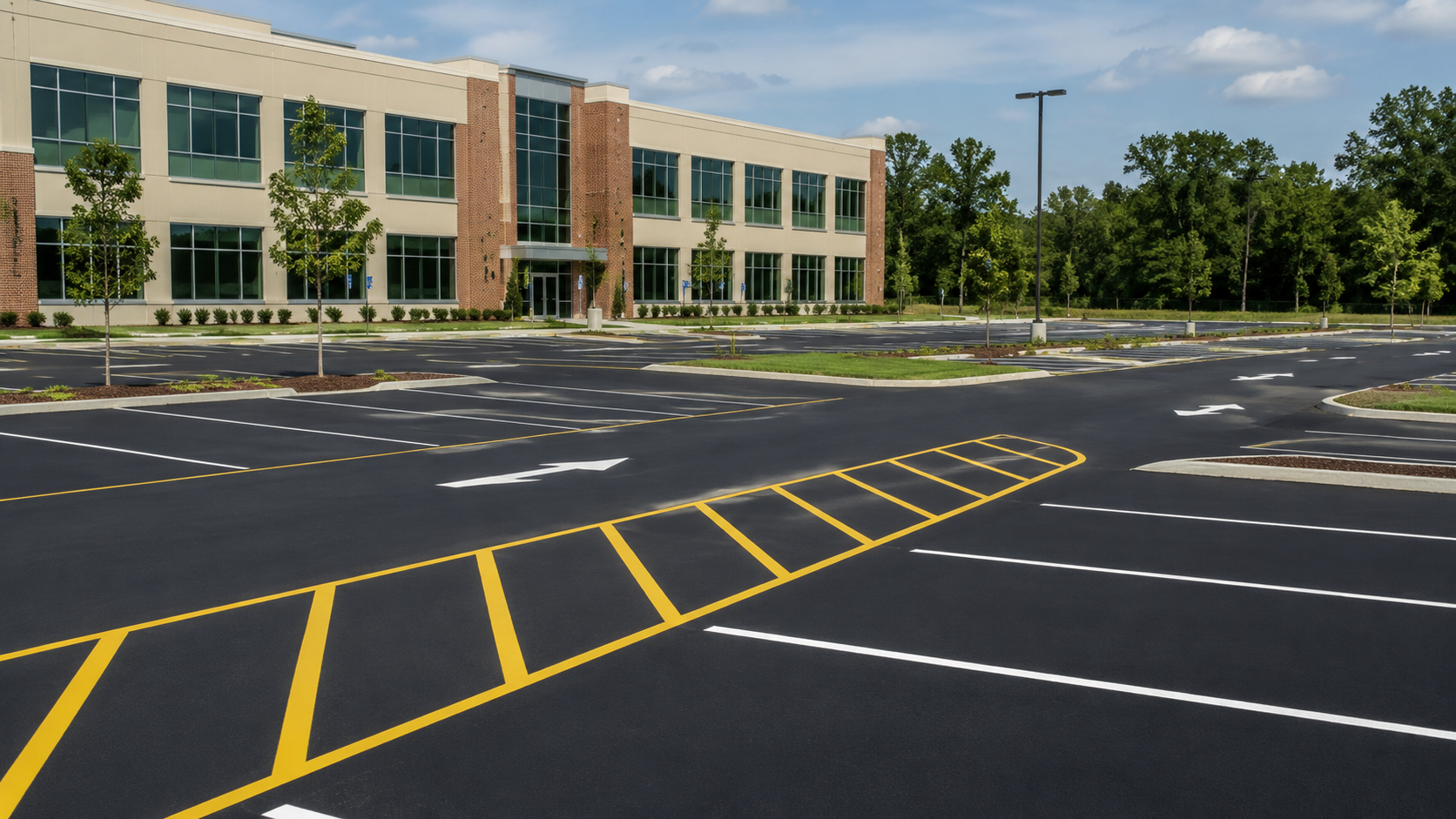
Why Church Parking Lots Deserve Special Attention
Church parking lots operate on a pattern unlike almost any other commercial property. Most of the time the lot sits largely empty — weekday mornings and midafternoons see minimal traffic. Then, on Sunday morning, the lot may handle more vehicles in a 30-minute window than a similarly sized retail lot sees in an entire day. Add in Wednesday evening services, youth group nights, committee meetings, funerals, weddings, and special seasonal events, and you have a high-peak, multi-use parking environment that has some unique needs when it comes to striping and layout.
This guide is written for church facility directors, business administrators, and pastors in Huntsville, Madison, Decatur, and Athens who are responsible for their church's parking lot maintenance. It covers the specific challenges of church lots, ADA requirements for places of public assembly, scheduling striping around services, and seasonal considerations that are unique to religious facilities.
The Unique Traffic Challenges of Church Lots
Church lots are visitor-heavy by nature. Unlike an office building or apartment complex where the same people park in the same places every day, a growing church may have a large percentage of first-time and occasional visitors who have no familiarity with the lot layout. Visitors need cues — clear stall marking, obvious pedestrian crosswalks, and intuitive one-way or two-way traffic designations — that regular users of a workplace lot might not need.
This matters for striping because faded or ambiguous markings that regular churchgoers have learned to navigate can genuinely confuse a first-time visitor. When a visitor's first experience at your church involves confusion about where to park, backing out of an aisle because they didn't realize it was one-way, or unsafely crossing the lot without a designated crosswalk, that's a poor first impression and a safety risk.
Peak entry traffic is also compressed. A Sunday morning service sees the majority of its attendees arrive within 15–20 minutes of service time, and depart within a similarly compressed window after the service ends. This means near-simultaneous entry and exit flows that test drive aisle capacity, turn radii at lot entrances, and pedestrian safety near building entrances. A well-marked lot — with clear directional arrows, defined pedestrian crossings, and obvious stall layout — helps the lot absorb that compressed traffic more efficiently.
Visitor Flow and Wayfinding Through Markings
Visitor flow is more important for church lots than for most commercial properties. Here's what good marking does for visitor flow, and what gaps in striping create problems.
Clear stall lines. Obvious, bright stall lines are the baseline. Visitors should never need to guess where a stall begins and ends. Faded lines allow informal parking patterns to develop — the car that parks diagonally across two stalls, the row that loses two spaces because the first driver parked off-center and everyone else followed. Restripe before fading gets to that point.
Directional arrows. If your lot has one-way drive aisles, those one-way designations need to be clearly painted — both as arrows on the pavement and, ideally, as posted signs. A visitor unfamiliar with the lot will follow paint cues before they follow a barely-visible signpost. Large, clear directional arrows in the drive aisles significantly reduce wrong-way entry and the near-miss incidents that result.
Designated visitor parking. Many churches reserve a section of the lot closest to the main entrance for visitors and guests. If you do this, those sections need clear "VISITOR PARKING" stenciling. First-time visitors shouldn't have to search for the right place to park while regular members have memorized the lot. Designated visitor marking communicates intentional hospitality before someone walks in the door.
Crosswalk placement. Crosswalks near building entrances, at lot exits, and at any point where pedestrians regularly cross drive aisles are one of the highest-safety-value line items a church can add to a striping project. A clear two-line or ladder-style crosswalk at the main entrance, combined with a pedestrian yield designation for drivers, gives pedestrians a defined safe path and gives drivers a clear visual cue to stop.
Crosswalk placement matters as much as crosswalk presence. A crosswalk placed where people actually walk — rather than where it's geometrically convenient — will actually be used. Watch where congregants naturally walk from parking to the building, and position crosswalks to match that path.
ADA Requirements for Places of Public Assembly
Churches are covered under the ADA's requirements for places of public accommodation, which means they must provide accessible parking that meets federal standards. The specific requirements depend on total parking lot capacity, and churches should be aware that they are not exempt simply because they are religious organizations. Under Title III of the ADA, religious entities are actually specifically exempt from Title III requirements — but they are not exempt from state and local building codes that mirror or exceed ADA standards. Consult with a qualified accessibility consultant or your local building department to confirm your specific obligations, since this varies by jurisdiction and property history.
That said, the practical reality is that most churches in the Huntsville area choose to provide ADA-compliant accessible parking regardless of strict legal requirement, because it's the right thing to do for members and visitors with mobility limitations. The standards for places of public assembly include:
- A minimum number of accessible spaces based on total lot capacity (1 per 25 spaces for the first 100, with decreasing ratios at higher counts)
- At least one van-accessible space per accessible parking area
- Accessible spaces located on the shortest accessible route to the accessible entrance
- Proper stall dimensions: 8-foot stall width minimum plus 5-foot access aisle for standard accessible; 8-foot stall plus 8-foot access aisle for van-accessible
- Correct ISA (wheelchair) symbols painted on the stall surface, plus vertical signs meeting height and placement requirements
- An accessible route (no curb barriers, no steps, appropriate slope) from the stall to the building entrance
If your church is planning a building addition, parking lot expansion, or major renovation, this is also a trigger for bringing the entire accessible parking layout into current compliance. A restripe project that modernizes faded ISA symbols and access aisle markings without addressing underlying dimensional deficiencies does not bring a lot into compliance — it just makes a non-compliant lot look newer. For a full breakdown of ADA parking marking requirements, see our page on ADA parking lot striping in Huntsville.
How to Schedule Striping Around Services and Events
Scheduling is one of the most practically challenging aspects of church lot striping, because unlike a retail lot that can be done in off-hours, a church's "off-hours" are also when striping crews typically want to work. Here's how to navigate the scheduling puzzle.
Monday through Wednesday morning is typically the best window for most churches. Sunday services are done, the lot is empty, and Wednesday evening activities haven't started yet. A full-day striping project can usually be completed comfortably within a Monday or Tuesday window, especially if the crew arrives early and the lot is clear.
Avoid scheduling the week before major events. Easter and Christmas are obvious examples, but also consider major fall kickoffs (back to school, fall revival), VBS week, and any large community events hosted at the church. A freshly striped lot looks great, but a partially completed job on the Thursday before Easter is worse than a faded lot.
Coordinate with the church office calendar well in advance. Churches often have the next 6–12 months of major events on the calendar. Request a quote and schedule your striping project during a window that avoids the three weeks around Easter, the Christmas season (typically Thanksgiving through New Year), VBS week, and any scheduled community events in the lot.
Communicate with volunteers and early arrivals. Even when the lot is striped on a Monday, dedicated volunteers may come in early for various ministries. A note in the church bulletin or email newsletter in the week prior — "The parking lot will be closed for restriping on Monday, May 21. Please use the side entrance lot if you need access before noon." — prevents confusion and ensures the work isn't interrupted.
Seasonal Event Considerations
Easter. Easter Sunday is typically the highest-attendance Sunday of the year at most churches. If your lot markings are faded, Easter is the worst time for them to be — you'll have more first-time visitors and unfamiliar drivers than any other day of the year. Aim to complete any restriping project at least 2–3 weeks before Easter, which means scheduling in February or early March.
Christmas. Christmas Eve and Christmas Day services are similarly high-attendance at many churches. The challenge here is that Huntsville's fall weather is more cooperative for striping than winter. Scheduling a restripe in October or early November — before the cold and wet season sets in and before the Christmas event calendar gets dense — is often ideal for churches that want fresh striping for the holiday season. Striping paint requires temperatures above 50°F and dry conditions, so late November through January can be difficult to schedule in North Alabama.
Vacation Bible School (VBS). VBS typically runs in the summer and generates significant parent drop-off and pickup traffic that the lot may not handle routinely. If your lot has crosswalk or fire lane issues, addressing them before VBS — typically before June — protects the safety of the children and families using the lot during a high-pedestrian week.
Fall and spring church kickoffs. Many churches hold large fall kickoff events and spring revival seasons that draw more visitors than a typical Sunday. These are good secondary benchmarks to have in mind when planning your striping schedule.
Sealcoating and Striping Coordination
If your church is planning both sealcoating and striping, the correct sequence is sealcoat first, then stripe — never the reverse. Sealcoat applied over fresh striping will bury the lines; it must be a fresh, cured sealcoat surface that receives the paint. Additionally, new sealcoat needs adequate cure time before the striping crew arrives. In Alabama's climate, that typically means at least 24–48 hours of dry weather with temperatures above 50°F.
Coordinate the sealcoating and striping contractors to ensure both can complete their work within the same scheduling window, ideally within the same week. If the sealcoat is applied on a Monday and cures through Tuesday, a Wednesday or Thursday stripe is typically appropriate. Build that sequence into your planning so the lot isn't left in a bare-sealcoat state — no markings, no stall lines, no fire lanes — over a Sunday service.
For more on the sealcoat-to-stripe sequence and timing, see our guide on striping after sealcoating. To get a quote for your church's parking lot in the Huntsville area, visit the Huntsville Stripe Pros homepage and submit a request.