
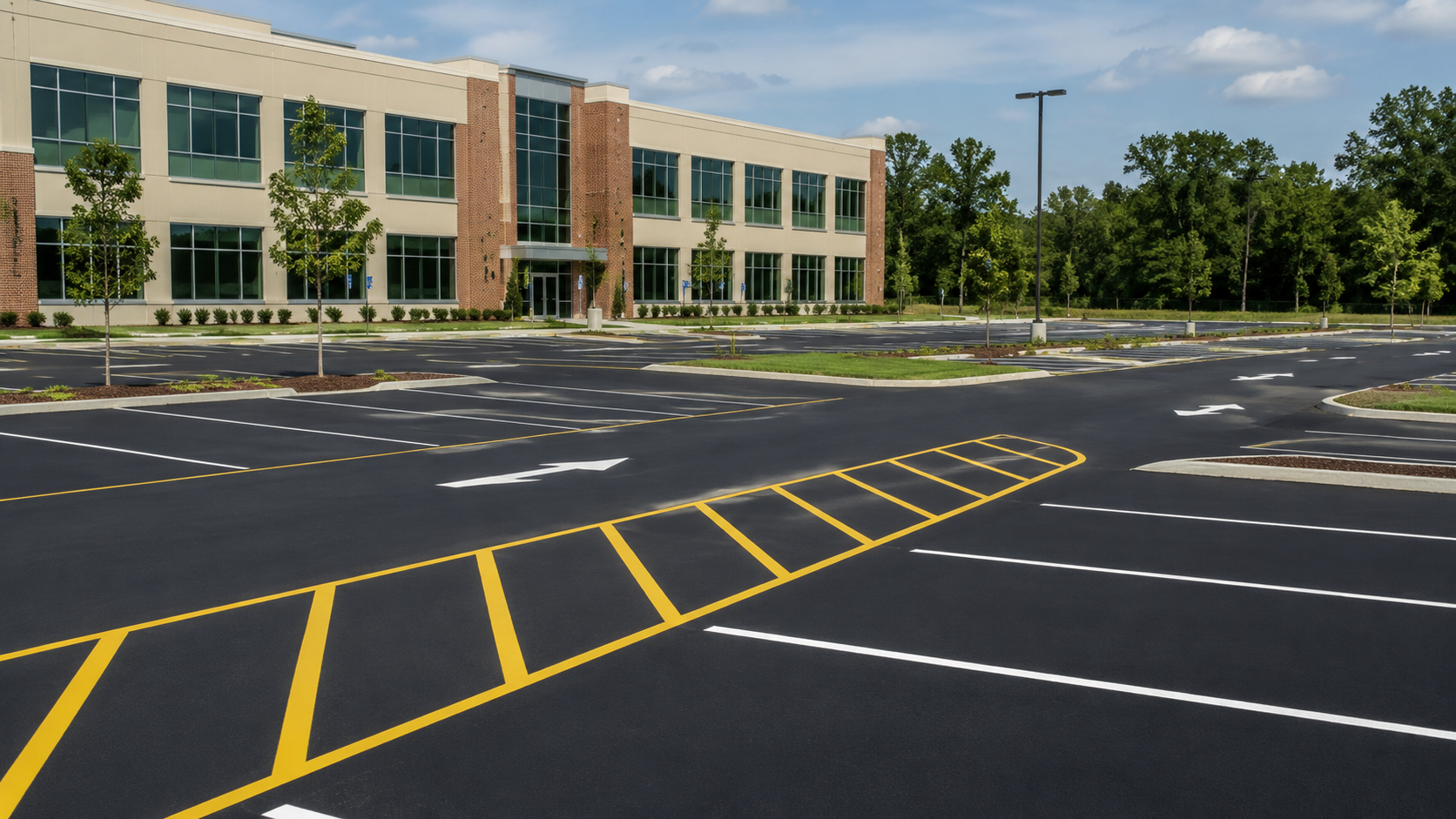
Why Line Width Matters More Than You Think
When most property owners think about parking lot striping, they focus on whether the lines are visible. Line width is rarely part of the conversation — until something goes wrong. A lot striped with inconsistent line widths loses usable stall count, creates ambiguity about stall boundaries, and can put a property out of ADA compliance without the owner ever realizing it. Understanding the standards behind line widths, stall dimensions, and aisle clearances helps commercial property owners in Huntsville, Madison, Decatur, and Athens make better decisions when hiring a striping contractor.
Standard Parking Stall Line Widths
The industry standard for parking lot stall lines on commercial asphalt surfaces is 4 inches wide. This width is specified in most municipal parking design standards and referenced in the Manual on Uniform Traffic Control Devices (MUTCD) for consistency. A 4-inch line is wide enough to be clearly visible from a moving vehicle, narrow enough to be precise, and efficient in paint consumption across a large lot.
Some contractors default to 6-inch lines, particularly in high-traffic environments, lots that experience rapid paint fade, or where the owner wants maximum visibility. Six-inch lines are also common on concrete surfaces, where the lighter substrate can make narrower lines look thinner than they are. There's nothing inherently wrong with 6-inch lines on a commercial lot — but there are two trade-offs to understand.
First, 6-inch lines consume approximately 50% more paint than 4-inch lines, which raises the cost of each restripe. Second, and more importantly, wider lines reduce usable stall width. In a tightly designed lot, switching from 4-inch to 6-inch lines across an entire parking grid can effectively consume the equivalent of one or two full stalls worth of linear space. On a 60-space lot, that's worth thinking about before deciding to upsize your line width.
The practical takeaway: 4-inch lines are the standard for most commercial asphalt lots, and they should be your default specification unless you have a specific reason to go wider. Ask any contractor bidding your job what width they plan to apply — it should be in the quote.
Standard Stall Dimensions for Commercial Properties
Standard parking stall dimensions for commercial lots in the United States typically fall in a range, and the specific dimensions your lot uses depend on when it was designed, what code requirements applied at that time, and how the layout was configured. Most commercial lots built in the last few decades use stalls that are 8.5 to 9 feet wide and 18 to 20 feet deep.
Nine feet wide by 18 feet deep is the most common configuration you'll see in retail and office parking in the Huntsville area. It accommodates most passenger vehicles comfortably and allows a standard 24-foot two-way drive aisle. Some older lots — particularly those built before the 1990s — use 8.5-foot-wide stalls, which were common when the average vehicle footprint was smaller. Today, 8.5-foot stalls feel cramped for many trucks and SUVs, and you'll often see these lots with vehicles parked over the lines.
Stall depth varies by intended use. A 90-degree stall with 18 feet of depth works for standard passenger vehicles, but 20-foot stall depth is preferred for lots that serve commercial trucks, delivery vehicles, or large SUVs frequently. Angled stalls — typically at 45 or 60 degrees — can use slightly shallower stall depths because vehicles don't need to travel as far into the space to be fully clear of the drive aisle.
Drive Aisle Widths: One-Way vs. Two-Way
Drive aisles — the travel lanes between rows of stalls — have their own minimum width standards, and they interact directly with stall angle and lot layout. Getting drive aisle widths right is critical for traffic flow, turning radius, and fire access compliance.
For 90-degree (perpendicular) stalls, standard drive aisle widths are:
- One-way traffic: 20–22 feet minimum. This allows vehicles to enter and exit stalls without requiring the opposing lane to stop. Some codes require 22 feet as a minimum for 90-degree one-way aisles.
- Two-way traffic: 24 feet minimum. This is the standard you'll see in most commercial parking lots — two vehicles passing each other while a third is backing out of a stall.
For angled stalls, drive aisle widths can be reduced:
- 60-degree angled stalls typically require a 16–18-foot one-way aisle.
- 45-degree angled stalls can work with aisles as narrow as 13–14 feet in one-way configurations.
The practical implication for striping: if you're redesigning a lot layout, specifying the wrong aisle width is a costly mistake. A layout drawn without accounting for fire lane minimums, turning radii at entrances, or ADA access aisle positions can force a redo of the entire design. A striping contractor doing a full layout (not just a repaint) should be measuring and confirming aisle widths as part of the job — not just repainting whatever was there before.
Fire apparatus access is also relevant here. Local fire codes in Huntsville generally require a minimum 20-foot clear width for fire apparatus access lanes. Lots where the striped fire lanes are too narrow, or where cars park in fire lanes because the lanes aren't clearly marked, can face fire marshal citations. When restriping fire lanes, confirm the marked width meets local requirements before finalizing the layout.
ADA Stall Width Requirements
The Americans with Disabilities Act has specific dimensional requirements for accessible parking stalls that go well beyond what standard commercial stalls require. Understanding the difference between a standard accessible stall and a van-accessible stall is essential for any property owner undertaking a striping project.
Standard accessible stalls require a minimum 8-foot-wide stall plus a 5-foot-wide access aisle, for a combined width of at least 13 feet. The access aisle must be at the same level as the stall surface (no raised curbs interrupting the path) and must connect directly to the accessible route leading to the building entrance.
Van-accessible stalls require either:
- A minimum 11-foot-wide stall plus a 5-foot access aisle (total 16 feet), or
- A minimum 8-foot-wide stall plus a 8-foot access aisle (total 16 feet — this is the more common configuration)
The van-accessible configuration also requires a minimum vertical clearance of 98 inches throughout the van-accessible route, including the entrance, aisle, and parking surface. This matters more for garages and covered lots than for open-air surface lots, but it's still relevant when there are overhead obstructions near the accessible stalls.
Every accessible parking area must have at least one van-accessible stall. Lots with six or more accessible spaces must have one van-accessible space for every six accessible spaces provided. This ratio can catch property owners off guard — if your lot has 12 accessible stalls, you need 2 van-accessible stalls, not 1.
Line width on ADA stalls deserves specific attention. Access aisles are typically marked with diagonal hatch lines to indicate they are not parking spaces. These hatch lines should be a different visual treatment than the stall lines themselves. A professional crew will apply the correct hatch pattern, position the International Symbol of Accessibility (ISA) correctly within the stall, and apply the correct pavement markings. DIY or discount striping work frequently gets these details wrong.
Why Consistency Is the Standard — and Why It's Hard to Achieve
A professionally striped lot looks consistent because it is consistent. Lines are parallel. Stalls are equal width. Arrows are centered. Symbols are properly scaled and positioned. This level of consistency requires a line striper with calibrated wheel tracking, accurate paint delivery, and an experienced operator.
Line striping machines used by professional crews apply paint at a consistent flow rate tied to the machine's travel speed, ensuring uniform line width even when the operator adjusts pace. The better machines — truck-mounted or self-propelled ride-on units — can hold a straighter line over long distances than a walk-behind unit, and they apply more consistent film thickness, which directly affects how long the lines last before fading.
DIY striping attempts using rented walk-behind machines or spray cans produce results that look passable from a car window but fall apart under scrutiny: lines that waver, stalls that gradually narrow or widen across a row, ADA symbols that are undersized or incorrectly positioned, and paint applied too thin to last through a full Alabama summer of UV exposure and rain.
The durability difference between professional striping and DIY striping is significant. Professionally applied traffic paint on a well-prepared surface in Huntsville's climate typically lasts 2–4 years before requiring restriping. DIY applications with consumer-grade paint may start fading in 6–12 months — and may never look crisp to begin with.
How Stall Count Is Affected by Line Width and Layout Precision
This is a practical point that rarely gets discussed but matters a great deal on lots with constrained dimensions. On a standard commercial lot, a few inches of cumulative error in stall width across a 10-stall row can eliminate an entire parking space. Here's how that happens.
If your lot design calls for 9-foot stalls and a contractor lays them out slightly wider — say, 9 feet 3 inches per stall — across a row of 10 stalls, that row consumes 2.5 feet more than planned. In a lot where a row has 11 stalls designed to fit within a fixed perimeter, you may end up with only 10. Multiply that by multiple rows and the lot may be delivering 5–8 fewer spaces than the design specified.
The reverse is also a problem. Stalls laid out at 8 feet 9 inches rather than 9 feet are below the standard dimension for accessible-adjacent rows and create the impression of cramped spaces that users will complain about. Precision in layout — achieved through proper use of measuring tools, snap lines, and a calibrated machine — is what separates a professional result from a sloppy one.
Confirming Compliance Before Striping Begins
If your lot hasn't been professionally measured in several years, it's worth confirming that the existing layout matches current ADA requirements and local code minimums before you simply restripe over the old lines. Restriping over a non-compliant layout doesn't fix the compliance problem — it just makes a non-compliant lot look fresh.
A professional striping contractor with ADA experience can walk your lot and flag issues before the job begins: access aisles that are too narrow, missing or incorrect pavement symbols, van-accessible stalls that are incorrectly dimensioned, or fire lanes that don't meet minimum width requirements. Catching these issues before the paint goes down is far less expensive than correcting them after.
For a detailed look at ADA-specific marking requirements for your commercial property, see our page on ADA parking lot striping in Huntsville. For a broader overview of what a full restripe involves, visit our parking lot restriping page. When you're ready to get a quote for your Huntsville, Madison, Decatur, or Athens property, the Huntsville Stripe Pros homepage has a quote request form to get the process started.