
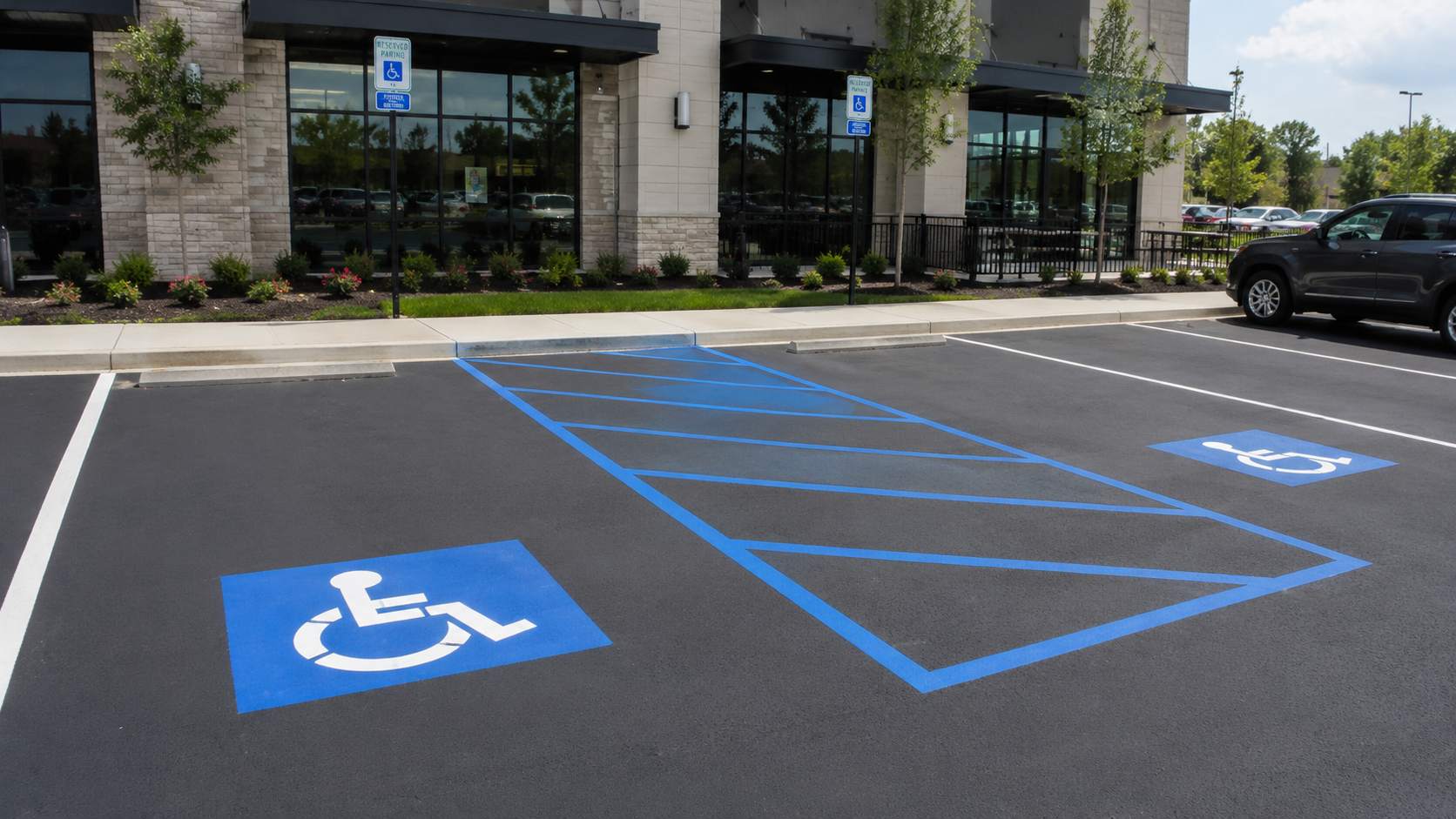
Why ADA Parking Space Requirements Matter for Commercial Properties
The Americans with Disabilities Act requires that parking lots serving commercial facilities, places of public accommodation, and state and local government buildings provide a minimum number of accessible parking spaces — and that those spaces be correctly designed, marked, and maintained. Getting this wrong creates legal exposure under federal civil rights law, not just local building codes.
For property managers, facility directors, and commercial property owners in Huntsville, Madison, Decatur, and Athens, understanding how many ADA spaces are required — and what makes a space actually compliant — is essential information. This post covers the 2010 ADA Standards for Accessible Design requirements for parking, the common mistakes property owners make, and what to do if your lot is currently under-compliant.
Note: This post is for general informational purposes. ADA compliance involves technical, legal, and site-specific factors. Verify your specific requirements with a qualified accessibility consultant, architect, or attorney before making changes to your property.
The 2010 ADA Standards Table: How Many Spaces Are Required
The 2010 ADA Standards for Accessible Design (Section 208.2) sets the minimum number of accessible parking spaces based on total lot capacity. The table is:
- 1–25 total spaces: 1 accessible space required
- 26–50 total spaces: 2 accessible spaces required
- 51–75 total spaces: 3 accessible spaces required
- 76–100 total spaces: 4 accessible spaces required
- 101–150 total spaces: 5 accessible spaces required
- 151–200 total spaces: 6 accessible spaces required
- 201–300 total spaces: 7 accessible spaces required
- 301–400 total spaces: 8 accessible spaces required
- 401–500 total spaces: 9 accessible spaces required
- 501–1000 total spaces: 2% of total spaces
- 1001 and over: 20 spaces plus 1 for each 100 spaces over 1000
These are minimums. Nothing prevents a property owner from providing more accessible spaces than required.
Note that outpatient medical care facilities have a higher minimum: at least 10% of spaces serving those facilities must be accessible. Rehabilitation facilities and outpatient physical therapy locations are also subject to higher minimums. Healthcare-adjacent commercial properties should verify their specific occupancy category carefully.
Van-Accessible Space Requirements
Of the total accessible spaces required, a specific minimum must be van-accessible. Van-accessible spaces are designed to accommodate vehicles with side-entry lifts or ramps, which require a wider access aisle than standard accessible spaces.
Under the 2010 ADA Standards, the requirement is:
- For every group of accessible spaces (or fraction thereof), at least one must be van-accessible
- In practical terms, this means that at least 1 in every 6 accessible spaces must be van-accessible
A van-accessible space requires either:
- An access aisle at least 96 inches (8 feet) wide adjacent to the space, or
- A standard 60-inch access aisle if the parking space itself is at least 132 inches (11 feet) wide
The van-accessible space must also have a vertical clearance of at least 98 inches (approximately 8 feet 2 inches) along the vehicular route to the space, at the space, and along the exit route. This is particularly relevant for covered garages and parking structures, but property owners should confirm clearances wherever van-accessible spaces are sited.
What Counts as an "Accessible" Stall
A stall is not accessible simply because it has an ISA symbol painted on it. Under the 2010 ADA Standards, an accessible parking space must meet all of these requirements:
- Minimum stall width: 96 inches (8 feet) for standard accessible spaces
- Access aisle width: At least 60 inches (5 feet) for standard accessible spaces; at least 96 inches (8 feet) for van-accessible spaces
- Access aisle length: The access aisle must run the full length of the parking space
- Slope: Both the space and the access aisle must have slopes not exceeding 1:48 (approximately 2%) in any direction. This is a critical field condition — many non-compliant spaces fail because of lot grading, not marking dimensions.
- Surface: Must be stable, firm, and slip-resistant
- Access aisle location: The access aisle must connect directly to an accessible route leading to the building entrance. A space is not compliant if the accessible route to the entrance requires crossing vehicle traffic lanes without a marked crosswalk or raised crossing.
- ISA marking: The International Symbol of Accessibility must be painted on the stall surface (pavement symbol) and displayed on a sign mounted at the required height
- Van-accessible identification: Van-accessible spaces must include the "Van Accessible" designation on signage
The access aisle is a shared element — two adjacent accessible spaces can share one access aisle between them. This is a common and acceptable configuration in efficiently designed accessible parking sections.
Common Mistakes Property Owners Make with ADA Parking
After years of ADA enforcement, several recurring errors show up repeatedly on commercial parking lots in Alabama and across the country:
Too few spaces. This is the most straightforward violation — the lot has fewer accessible spaces than required by the table. It often results from lot expansions that added total spaces without adding accessible spaces, or from poorly designed original layouts.
Wrong stall dimensions. Standard accessible spaces that are only 8 feet wide with a 4-foot access aisle instead of the required 5-foot aisle. This is a very common deficiency on older lots that were marked before the 2010 Standards took full effect.
No van-accessible space. Properties that have two or three accessible spaces but none of them meet van-accessible dimensions. With the 1-in-6 requirement, any lot with accessible spaces should have at least one van-accessible space.
ISA symbol in the wrong location. The ADA requires the ISA symbol to be on the pavement within the parking space, not just on signage. Many older lots have a sign but no pavement symbol.
Signs at the wrong height or missing. ADA signage must be mounted with the bottom of the sign at least 60 inches from the ground, and must identify van-accessible spaces. Signs attached to the ground in front of the space (bollard-style) are not compliant unless they meet the height requirements.
Accessible spaces in the wrong location. ADA-accessible spaces must be on the shortest accessible route from the parking area to the accessible building entrance. A property with its accessible spaces at the far end of the lot, far from the accessible entrance, may be technically marked but still non-compliant in terms of location.
Improper slopes. Accessible spaces that were designed correctly on paper but where the actual paved surface has a cross-slope exceeding 2% due to drainage grading. This is harder to detect without measurement tools but is an enforcement vulnerability, especially after resurfacing work that changed surface grades.
Faded markings. Accessible pavement markings that are so worn that the ISA symbol and access aisle boundary are no longer legible. Faded markings don't meet the visual identification requirement and invite non-disabled drivers to park in the space.
How to Count Stalls in a Multi-Building or Multi-Use Campus
Commercial campuses with multiple buildings, parking structures, and surface lots add complexity to ADA counting. The general principle under the ADA is that accessible parking calculations apply to each parking facility — not just the total number of spaces across a campus — and accessible spaces must be located on an accessible route to the building entrance they serve.
For multi-building office parks or retail centers, this means that parking areas that serve different buildings may need to be treated separately for calculation purposes, and accessible spaces need to be sited relative to each building's accessible entrance. A campus where all accessible spaces are concentrated near one building while other buildings are served only by remote non-accessible spaces is likely non-compliant even if the total count is technically correct.
For mixed-use properties where some spaces serve a medical facility and others serve retail or office uses, the higher medical facility minimum (10%) applies to the spaces serving the medical building, not the entire lot. This requires careful analysis of the lot layout and how spaces are allocated to different uses.
Multi-building situations benefit from a systematic audit by an accessibility consultant who can assess the spatial relationships between parking, accessible routes, and building entrances — not just count spaces on paper.
What to Do If Your Lot Is Under-Compliant
If a review of your lot reveals that it has fewer accessible spaces than required, incorrect dimensions, missing van-accessible spaces, or other deficiencies, the path forward typically involves:
- Documenting current conditions. Photograph existing markings, measure current stall and aisle dimensions, and count total and accessible spaces. This creates a baseline for comparison after corrective work.
- Consulting with a qualified professional. Before spending money on repainting, confirm what your specific lot actually needs. An accessibility consultant, architect, or attorney familiar with ADA Title III (for places of public accommodation) or Title II (for government facilities) can identify what corrections are necessary and help you prioritize if budget is a constraint.
- Reconfiguring if needed. Sometimes adding or relocating accessible spaces requires more than repainting — it may require adjusting the lot layout, adding spaces, or moving the location of existing accessible stalls to a position closer to the accessible entrance. This can affect the overall stall count and aisle design.
- Engaging a striping contractor. Once the correct layout is confirmed, a striping contractor handles the marking work — painting access aisles at correct dimensions, applying ISA symbols, adding "VAN ACCESSIBLE" text, and repainting stall boundaries to meet the dimensional standards. See our ADA parking lot striping service page for more on what this work involves.
- Updating or adding signage. Pavement markings alone are not sufficient — compliant signage mounted at the correct height is also required. Coordinate sign installation with your striping project.
- Document the corrections. Keep dated photographs and measurement records of the corrected configuration. This documentation is valuable if a complaint is ever filed.
Ready to Review or Correct Your Accessible Parking?
If you're not confident that your Huntsville, Madison, Decatur, or Athens commercial property has the right number of correctly dimensioned ADA spaces, a site review is the right starting point. Contact our team to discuss your property's accessible parking configuration and get a quote for any marking work needed. Visit our ADA parking striping page or the homepage to get in touch.