
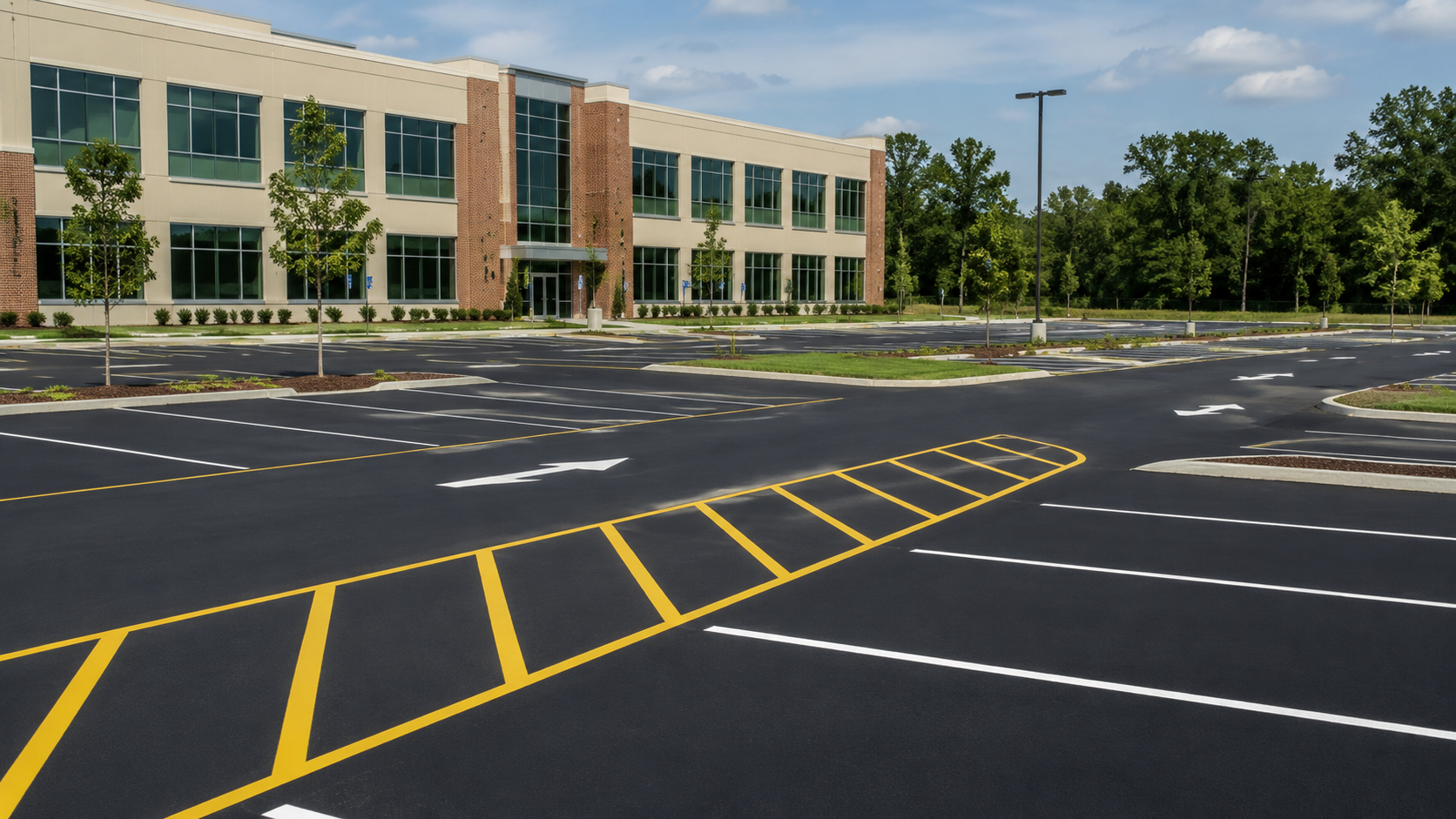
Why Traffic Flow Is a Serious Safety and Operations Issue
Walk through any poorly designed commercial parking lot and you'll notice the same friction points: confused drivers hesitating at unmarked intersections, wrong-way conflicts in narrow aisles, pedestrians stepping out between parked cars with no visual warning for drivers, and the general sense that the lot wasn't designed for how it's actually used. These aren't just annoyances — they're the conditions that lead to fender-benders, pedestrian incidents, and operational headaches for property managers.
Good traffic flow in a commercial parking lot starts with design, but it's maintained through pavement markings. Directional arrows, stop bars, one-way aisle indicators, pedestrian crossings, and lane delineators are the tools that guide driver behavior when there are no physical barriers, no traffic signals, and no staff directing traffic. Getting these markings right — and keeping them readable — is one of the most practical things a property owner can do to reduce liability, reduce minor accidents, and improve the experience for customers and tenants.
This post covers the types of pavement markings used for traffic flow in commercial lots, how placement affects outcomes, common design mistakes, and how to work with a striping contractor to improve or refresh your lot's flow markings.
Types of Pavement Markings Used for Traffic Flow
Directional flow in a parking lot is managed through a system of pavement markings, each with a specific function:
Directional arrows. The primary tool for indicating travel direction in parking aisles. Standard parking lot directional arrows are typically 4 to 6 feet long (some jurisdictions or lot designs use larger arrows for visibility), applied in white or yellow paint. In one-way aisles, a single arrow points in the direction of travel. In two-way aisles, bidirectional or chevron arrows may be used, though many designers prefer physical separation for two-way flow rather than relying on paint alone.
Stop bars. A solid white or yellow line across a travel lane at an intersection with a main aisle or drive lane. Stop bars indicate where a driver should stop before entering cross-traffic. They're especially important at lot entrances and exits, at intersections between drive aisles and main through lanes, and anywhere a sightline is limited by parked vehicles or landscaping. Stop bars reduce right-angle conflicts that cause the most common type of parking lot collision.
One-way indicator markings. Beyond arrows, some lots use text stencils ("ONE WAY") or diagonal hash markings to reinforce one-way restrictions. These are particularly useful at lot entrances where drivers may be unfamiliar with the circulation pattern, and at transitions from two-way main lanes to one-way aisles.
Crosswalk markings. Pedestrian crossings from parking areas to building entrances should be marked with ladder-style or parallel-stripe crosswalks. These create a visual cue for both pedestrians and drivers. On high-traffic properties — retail centers, medical offices, schools — crosswalk markings are a significant safety element. Paint alone doesn't guarantee safety, but unmarked pedestrian routes are consistently more dangerous than marked ones.
Lane delineators and edge lines. On wider drive lanes or at lot entrances shared with vehicle queuing (such as a drive-through or drop-off zone), edge lines define the usable lane width and prevent encroachment. These are common at medical and healthcare facilities with porte-cocheres or drop-off circles.
Speed limit and warning stencils. "5 MPH," "SLOW," "CAUTION — PEDESTRIANS" and similar text stencils reinforce behavioral expectations in zones where conflicts between vehicles and pedestrians are likely. These markings are common near building entrances, crosswalks, and tight corners.
No-parking and restricted area markings. Hash marks, diagonal yellow stripes, or text stencils identify areas where parking is restricted — fire lanes, loading zones, tow-away zones — that contribute to maintaining clear travel lanes.
How Arrow Placement Reduces Accidents and Improves Throughput
The placement of directional arrows in a parking lot is more nuanced than simply pointing down each aisle. Effective placement requires thinking about driver decision points — where does a driver need to know which direction to go, and where do they currently have no visual guidance?
Key placement principles:
- Place arrows at the beginning of each aisle, visible from the main drive lane. Drivers entering a parking row should see the directional arrow before they commit to entering — not after they're already in the aisle. An arrow placed 50 feet into the aisle doesn't help the driver who just turned in from the wrong end.
- Repeat arrows in long aisles. A 200-foot aisle with only one arrow at the entrance is less effective than one with arrows placed every 60 to 80 feet. Repeated arrows reinforce the direction and remain visible even when cars are parked in the aisle.
- Use stop bars consistently at all cross-aisle intersections. Even if drivers know who has the right-of-way conceptually, a stop bar makes the requirement explicit and slows approach speeds at intersections where sightlines are limited.
- Coordinate arrows with physical entry/exit points. If an aisle only has an entry at one end (because the other end connects to a fire lane or pedestrian walkway), the arrow placement and any barriers or markings should be consistent.
- Use "wrong-way" hash marks at one-way aisle exits. Diagonal hash stripes or "DO NOT ENTER" stencils at the far end of one-way aisles prevent drivers from entering from the wrong direction, which is a common source of wrong-way conflicts in retail lots.
Poor arrow placement — or having no arrows at all — leads to bidirectional conflicts in one-way aisles, right-angle collisions at uncontrolled intersections, and pedestrian conflicts at unmarked crossings. Minor collisions in commercial parking lots are more common than most property managers realize, and they often involve vehicles moving at low speed but generating significant damage claims and insurance consequences.
Common Traffic Flow Mistakes in Retail and Apartment Lots
The parking lots that generate the most conflict and confusion in Huntsville and the surrounding area tend to share a few recurring design and marking deficiencies:
Bidirectional use of aisles designed for one-way flow. A lot with stalls angled at 60 degrees — which was designed for one-way circulation — often has drivers going both ways because the one-way arrows were never installed or have faded beyond recognition. Angled stall configurations look fine with bidirectional traffic until two cars meet head-on in a narrow aisle.
No stop bars at the main through lane. Small office or retail lots often have no stop bars at the intersection between parking aisles and the main drive lane that runs parallel to the building. Drivers pulling forward out of parking spaces or driving down aisles have no visual signal to stop before entering the main lane, which gets traffic moving at higher speed.
Missing crosswalk between the parking area and the front door. This is extremely common on smaller commercial properties. There's a clear pedestrian desire line from the parking area to the entrance, but no crosswalk marking. Drivers don't know to expect pedestrians there, and pedestrians feel exposed because there's no visual designation of their crossing.
Arrows that were painted once and never refreshed. A 10-year-old set of directional arrows that has faded to near-invisible provides almost no guidance benefit. Drivers who aren't familiar with the lot have no way to know what the intended circulation pattern is. Refreshing these markings should be part of every restripe cycle.
Apartment complex lots with no flow logic at all. Multi-family parking areas are often completely uncontrolled — no arrows, no stop bars, no crosswalks. The result is chaos in the lot, especially at move-in/move-out times or events. Adding a basic flow marking system significantly improves day-to-day lot operation.
Drive-throughs that conflict with parking aisles. Quick-service restaurant lots frequently have drive-through queues that back up into parking aisles with no markings indicating the queue boundary. Adding "DRIVE-THRU QUEUE" delineation or directional arrows that route through-lane traffic correctly can prevent gridlock during peak hours.
When to Reconfigure vs. When to Repaint
Property managers facing traffic flow problems need to decide whether the issue requires a genuine redesign of the circulation pattern or simply a refresh and addition of markings within the existing layout. This is an important distinction because reconfiguration can affect stall count, require changes to curbing or islands, and may trigger permitting or ADA re-evaluation.
Repaint-only situations:
- The original flow design was sound but markings have faded and drivers no longer follow it
- Arrows need to be added to aisles that were never marked or where markings were omitted in previous stripe jobs
- Stop bars are missing or faded at intersections that were designed correctly
- Crosswalk markings need to be added at a pedestrian crossing that already has clear clearance
Reconfiguration situations:
- The original design placed one-way aisles in a configuration that creates difficult entry/exit patterns that drivers consistently fight
- A change in tenant or use has shifted where the majority of pedestrian and vehicle traffic enters the property
- A new drive-through, building addition, or adjacent development has changed the traffic dynamics significantly
- The lot needs to be expanded or reconfigured to add accessible spaces and the new layout changes the circulation pattern
Reconfiguration typically involves a planning phase — sometimes involving a simple CAD drawing or even a hand-sketched layout — before the striping contractor shows up. Getting the new design right before paint touches the asphalt is much cheaper than repainting a second time to fix errors. Contractors who specialize in commercial parking lot striping, like the team at Huntsville Stripe Pros, can often help with basic layout planning as part of the quoting process.
How to Communicate Flow Design to a Striping Contractor
One of the most common misunderstandings between property managers and striping contractors happens when a property manager wants to add or change directional markings but hasn't clearly communicated the intended flow pattern. The contractor shows up expecting a restripe and is asked to make design decisions on the spot, which leads to inconsistent results.
For best results, provide the contractor with:
- A simple diagram of the intended flow. This doesn't need to be a professional drawing. A sketch on paper or a marked-up aerial photo from Google Maps clearly showing which aisles are one-way, where stop bars should go, and where crosswalks should be placed is enough for an experienced contractor to work from.
- Specific stencil requirements. List the stencil types you need: directional arrows, stop bars, crosswalks, "ONE WAY" text, "DO NOT ENTER" at certain aisle entrances, speed limit markings, etc. Be specific about what goes where.
- Photos of any specific problem areas. If there's a corner where wrong-way conflicts happen constantly, or an unmarked pedestrian path that's a safety concern, photograph it and share it with the contractor. This gives them context that a sketch alone may not convey.
- Priority areas if budget is a constraint. If you can't do everything at once, identify which flow improvements are most urgent — typically those associated with accident history, near-misses, or pending liability concerns — and have those done first.
A professional contractor should be able to take that input and execute it precisely. If they're unsure about placement of any marking, they should ask before painting — not after. Clear communication upfront prevents costly repaints and ensures the job delivers the traffic management results you're paying for.
Getting a Flow Marking Assessment for Your Lot
If your commercial parking lot in Huntsville, Madison, Decatur, or Athens has faded or missing directional markings, or if you've noticed recurring traffic conflicts that a better-marked lot would help reduce, a quote from a professional striping contractor is the right starting point. Visit our parking lot striping page or the restriping page to learn more, or head to the homepage to request an estimate.