
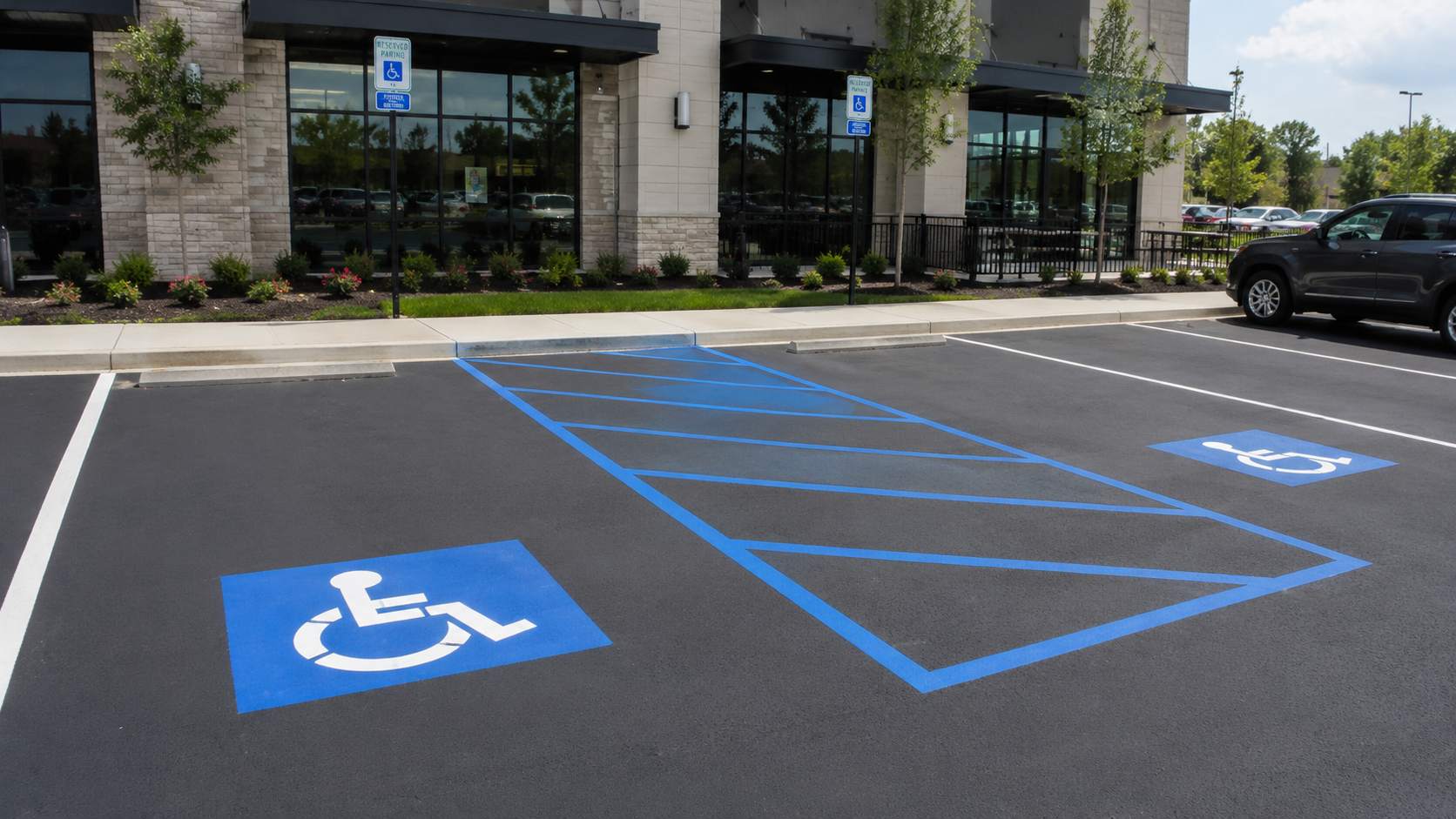
Van-Accessible vs. Standard Accessible: What's the Difference?
The 2010 ADA Standards for Accessible Design distinguish between two types of accessible parking stalls: standard accessible and van-accessible. Both require width and access aisle dimensions that accommodate wheelchair users, but van-accessible stalls are specifically designed to accommodate wheelchair-lift equipped vans — vehicles that deploy a lift or ramp from the side and need significantly more clear space to operate safely.
Understanding the difference matters for commercial property owners in Huntsville because the marking requirements, dimensions, and signage for van-accessible stalls are different from standard accessible stalls — and non-compliance with van-accessible requirements is one of the most common ADA parking violations found during accessibility audits.
Minimum Dimensions: What the Standards Require
The 2010 ADA Standards provide two ways to configure a van-accessible stall. The most common configuration is a standard-width stall (minimum 96 inches wide) with a wider access aisle — the access aisle must be at least 96 inches wide rather than the 60-inch minimum for standard accessible stalls. This "shared access aisle" configuration allows two van-accessible stalls to share one 96-inch aisle between them, which is how most commercial properties configure their accessible section.
The alternative configuration is a stall that is itself at least 132 inches wide, with a standard 60-inch access aisle. This configuration is less common in commercial parking because it requires significantly more total width for the stall alone. The shared-aisle configuration typically provides more efficient use of the available parking section.
For reference: a 96-inch stall with a 96-inch access aisle, positioned adjacent to another 96-inch stall with a shared aisle, requires a total width of approximately 20 feet for the two-stall van-accessible section. This is roughly equivalent to two standard parking stalls, which is why retrofitting van-accessible stalls into an existing lot sometimes requires restriping the entire accessible section to make the geometry work.
How Many Van-Accessible Stalls Are Required?
The 2010 ADA Standards require that at least one of every six accessible stalls (or fraction thereof) be van-accessible. In practice:
- 1 to 6 accessible stalls required: at least 1 must be van-accessible
- 7 to 12 accessible stalls required: at least 2 must be van-accessible
- 13 to 18 accessible stalls required: at least 3 must be van-accessible
For most small and mid-size commercial lots in Huntsville — a strip center, a church, a medical office — the lot will have between 4 and 8 required accessible stalls, meaning 1 van-accessible stall meets the minimum. Larger properties with 100 or more total parking spaces may have higher accessible stall counts and correspondingly more van-accessible requirements.
Note that the "required" accessible stall count is based on total parking spaces in the lot, not just the spaces near one building entrance. Multi-building campuses must calculate accessible stall requirements across the full lot. If your lot has sections that aren't adjacent to any entrance, those spaces still count toward the total, and accessible stalls must be distributed to serve each building entrance.
Signage Requirements for Van-Accessible Stalls
Every van-accessible stall must have a sign that includes the International Symbol of Accessibility and the words "Van Accessible." This sign must be mounted at a height where it is visible from the driver's seat of a vehicle parked in the stall — the bottom of the sign must be at least 60 inches above the ground surface.
The "Van Accessible" designation is not satisfied by the general accessible stall sign alone. A property that has the ISA sign but not the supplemental "Van Accessible" text is technically non-compliant for van-accessible designation, even if the stall dimensions are correct. This is one of the most common compliance gaps found during ADA audits: the marking dimensions are right, the blue paint is there, but the sign says only "Accessible" rather than "Van Accessible."
Surface Markings for Van-Accessible Stalls
The surface markings for van-accessible stalls follow the same pattern as standard accessible stalls: blue background paint covering the stall surface, the International Symbol of Accessibility stenciled in white on blue, white stall boundary lines, and cross-hatch access aisle marking. The key difference is the access aisle dimensions — 96 inches wide rather than 60 — and the optional "VAN ACCESSIBLE" or "VAN" stencil on the pavement surface itself.
Some striping contractors include the pavement stencil for van-accessible as standard; others treat it as a separate item. When requesting a quote for ADA work, ask specifically whether van-accessible stalls will be marked with the supplemental "VAN" stencil on the pavement in addition to the required sign.
Why Medical and Healthcare Properties Face Extra Scrutiny
Medical offices, hospitals, outpatient clinics, and healthcare facilities in Huntsville face heightened scrutiny on ADA parking compliance for a straightforward reason: their patients are disproportionately likely to require accessible parking, including van-accessible stalls. A medical office with a non-compliant van-accessible stall is more likely to actually harm a real patient who needs that configuration than a retail property where accessible parking use is lower.
The practical consequence is that medical properties tend to face ADA complaints more frequently, and insurance carriers that cover healthcare facilities sometimes conduct their own ADA compliance reviews. Medical property managers in the Huntsville area — particularly on the US 72 medical corridor in Madison, near Huntsville Hospital, and in the Research Park medical office cluster — should treat ADA parking compliance as a higher-priority item than general commercial property managers might.
What to Do If Your Lot Is Out of Compliance
If your property has van-accessible stall deficiencies — wrong dimensions, missing signage, faded surface markings, or an insufficient count — the correction process is typically straightforward: have a striping contractor assess the current configuration and re-mark the stalls to the correct dimensions, add or replace signage, and provide completion documentation.
In some cases, the geometry of the existing accessible section won't accommodate a properly dimensioned van-accessible aisle without restriping adjacent stalls. A contractor who has reviewed the site can tell you whether a simple re-mark is sufficient or whether a section redesign is needed. This is worth knowing before you schedule the work, because it affects both scope and cost.
Property owners should verify specific requirements with a qualified accessibility professional or legal advisor — the information in this guide reflects general 2010 ADA Standards, but how those standards apply to your specific property depends on factors including when the property was constructed, whether alterations trigger full compliance, and applicable state and local requirements. See our full ADA parking lot striping page for more on accessible marking services in Huntsville.
Request an ADA Marking Assessment
If you're not sure whether your accessible and van-accessible stalls are compliant, the first step is a site assessment. Visit the Huntsville Stripe Pros homepage to request a quote that includes an ADA stall count review for your property in Huntsville, Madison, Decatur, Athens, or surrounding North Alabama communities.