
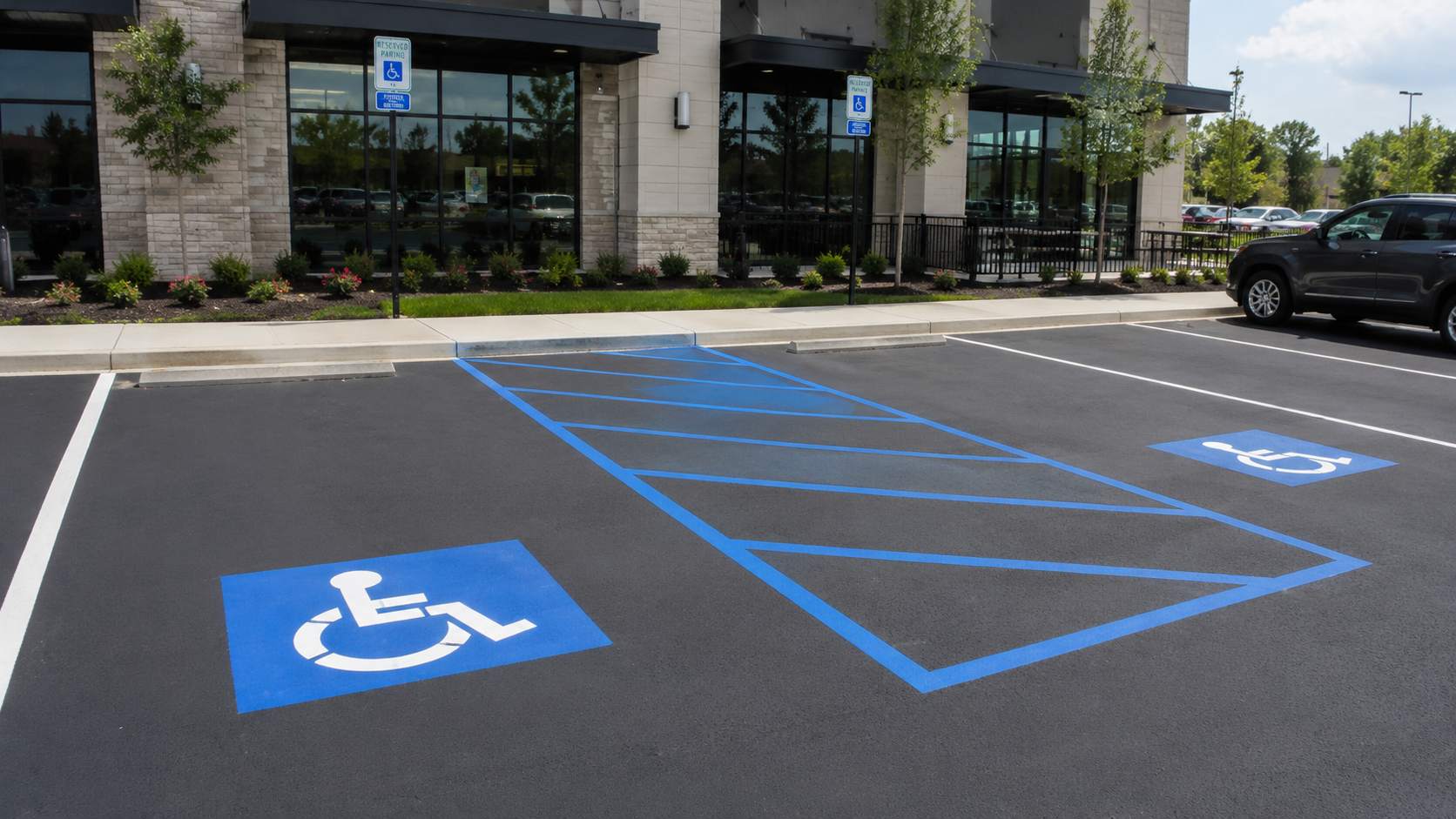
Why ADA Parking Markings Matter on Commercial Lots
Accessible parking spaces aren't just painted stalls — they're a required component of a commercial property's parking layout under federal law, and they need to be clearly marked to function properly. For property owners and managers in Huntsville, Madison, Decatur, and Athens, AL, understanding the basic elements of ADA-compliant parking markings helps you ask the right questions when planning a striping or restriping project, and helps you recognize when your current markings are no longer meeting the standard.
This guide covers the core components of accessible parking markings, when to refresh them, how they differ from standard stalls, and what to tell your contractor when requesting ADA striping work. Note that specific ADA requirements for your property should be verified with a qualified professional — requirements can vary based on property type, total parking count, jurisdiction, and other factors.
The Key Elements of ADA Parking Markings
A properly marked accessible parking area typically includes several distinct components that must all be legible for the space to function as intended:
- Accessible stall lines. The stall itself must be wide enough to meet ADA standards. Standard accessible spaces require a minimum width; van-accessible spaces require a greater width to accommodate wheelchair lifts and ramps.
- Access aisle. Every accessible space must have an adjacent access aisle — a marked zone that must remain clear so a person using a wheelchair or other mobility device can safely transfer from their vehicle. Access aisles cannot be used as parking spaces and must be clearly delineated on the pavement.
- Pavement symbols. The International Symbol of Accessibility (the wheelchair symbol) is typically painted on the stall surface. Van-accessible stalls typically include additional text indicating van accessibility.
- Signage coordination. Pavement markings work alongside vertical signs, not in place of them. The sign placement and height requirements are separate from the paint work, but your striping contractor should understand how the two interact.
Standard Accessible vs. Van-Accessible Spaces
One of the most commonly misunderstood aspects of accessible parking layout is the difference between a standard accessible space and a van-accessible space. ADA standards require that at least one accessible space in each group be van-accessible, meaning it has a wider access aisle to accommodate a vehicle-mounted lift or ramp. Van-accessible spaces are sometimes confused with standard accessible spaces during striping, resulting in markings that don't meet the required dimensions.
When you request accessible parking striping, make sure your contractor understands whether the job includes van-accessible stalls and what the dimensional requirements are for your specific lot configuration. If your lot has not been assessed by someone familiar with accessibility standards, this is worth verifying before the paint goes down.
How Many Accessible Spaces Does My Lot Need?
Federal ADA standards set minimum ratios of accessible spaces to total parking spaces for most commercial facilities. The more total spaces a lot has, the more accessible spaces are required — and a specific minimum of those must be van-accessible. For example, a lot with 1 to 25 total spaces requires at least 1 accessible space; a lot with 26 to 50 spaces requires at least 2; and so on up the scale.
These are minimums. Local building codes, state requirements, or specific facility types (medical offices, transit facilities, outpatient rehabilitation centers) may require a higher ratio. If you're unsure whether your lot has the correct count, a building official or accessibility consultant familiar with Alabama requirements can review your layout.
When ADA Markings Need to Be Refreshed
Accessible parking markings fade for the same reasons all pavement paint fades — UV exposure, vehicle traffic, weather cycles, and age. But the stakes are higher when it's ADA markings that become unclear. When the wheelchair symbol is no longer visible, when the access aisle boundaries are hard to see, or when faded paint makes it unclear which space is accessible and which is standard, the marking has lost its function.
Common situations that call for ADA marking refresh or reapplication include:
- Symbols or aisle markings are faded to the point of being difficult to read from a standing or driving position
- The lot has been sealcoated, covering all previous markings
- The lot is being restriped and accessible spaces should be included in the refresh
- A tenant, visitor, or inspector has flagged that the accessible area markings are unclear
- The lot layout is being reconfigured, adding or moving accessible stalls
- Access aisles have been partially blocked or repainted over incorrectly by a previous contractor
ADA Markings and the Restriping Process
When a lot is fully restriped, the accessible parking section should be included as part of the complete layout — not treated as an afterthought. A contractor familiar with accessible parking requirements will measure and position stalls and access aisles correctly, apply the appropriate symbols and text, and leave a clear notation of which spaces are van-accessible.
If your lot is being restriped after sealcoating, this is the right time to verify that your ADA layout still matches your total stall count. Lot expansions, reconfigured layouts, or changes in occupancy type may mean the previously compliant layout no longer meets current requirements. Our full guide on restriping after sealcoating covers sequencing and planning for those projects.
Common Problems Found on Older Lots
Parking lots in commercial areas around Huntsville that haven't been evaluated in several years sometimes show patterns worth knowing about:
- Access aisles that are too narrow because they were originally laid out to an older standard
- Van-accessible spaces that were marked with only a standard symbol, with no "VAN ACCESSIBLE" text
- Access aisles that have been partially blocked by planters, shopping cart corrals, or equipment left too close to the marked zone
- Symbols that have been painted over during a restripe job that didn't include the ADA section
- Stalls positioned on a slope that doesn't meet slope requirements for accessible surfaces
Many of these issues stem from older installations that predate updated standards, or from restripe jobs where the contractor was not fully briefed on the ADA requirements for that specific lot. A thorough quote request that includes a current photo of the accessible area helps your contractor identify and flag potential issues before work begins.
Requesting ADA Marking Work in Huntsville
When you contact a parking lot striping contractor for accessible marking work, it helps to share the following information:
- Total number of parking spaces in the lot
- Current number of marked accessible spaces and whether any are van-accessible
- Photos of the current accessible area, including stalls, access aisles, and symbols
- Whether the lot is being fully restriped or only the ADA section is being refreshed
- Whether signage is already in place or needs to be evaluated
- Any notices or flagged concerns from tenants, visitors, or inspectors
This detail allows the contractor to quote accurately and plan the layout correctly before arriving on-site. Learn more on our dedicated ADA parking lot striping page, or request an estimate for your Huntsville commercial property from the homepage.